
Travel Management System Auditing: A 2026 Strategic Checklist
Updated: Aug 30
Is your travel technology actually serving your business, or is it just creating a series of expensive hurdles for your employees? Many organizations realize too late that their infrastructure has become a collection of disconnected silos rather than a cohesive strategy. When data is fragmented across multiple platforms, traveler friction increases. This often leads to "leakage" as employees book outside the approved system to avoid frustration. Because of these complexities, travel management system auditing has evolved from a simple compliance check into a critical diagnostic for your organization's digital health.
You likely feel the pressure to integrate AI and meet 2026 tech standards while keeping operational costs under control. It's a common challenge, but it doesn't have to be an overwhelming one. I'll help you identify the gaps in your current stack and align your system architecture with 2026 digital standards. This article provides a clear roadmap to modernize your travel technology through a strategic checklist. We'll examine the process of system integration to reduce operational costs and improve employee satisfaction through seamless digital workflows that prioritize both efficiency and the traveler experience.
Table of Contents
What is Travel Management System Auditing in 2026?
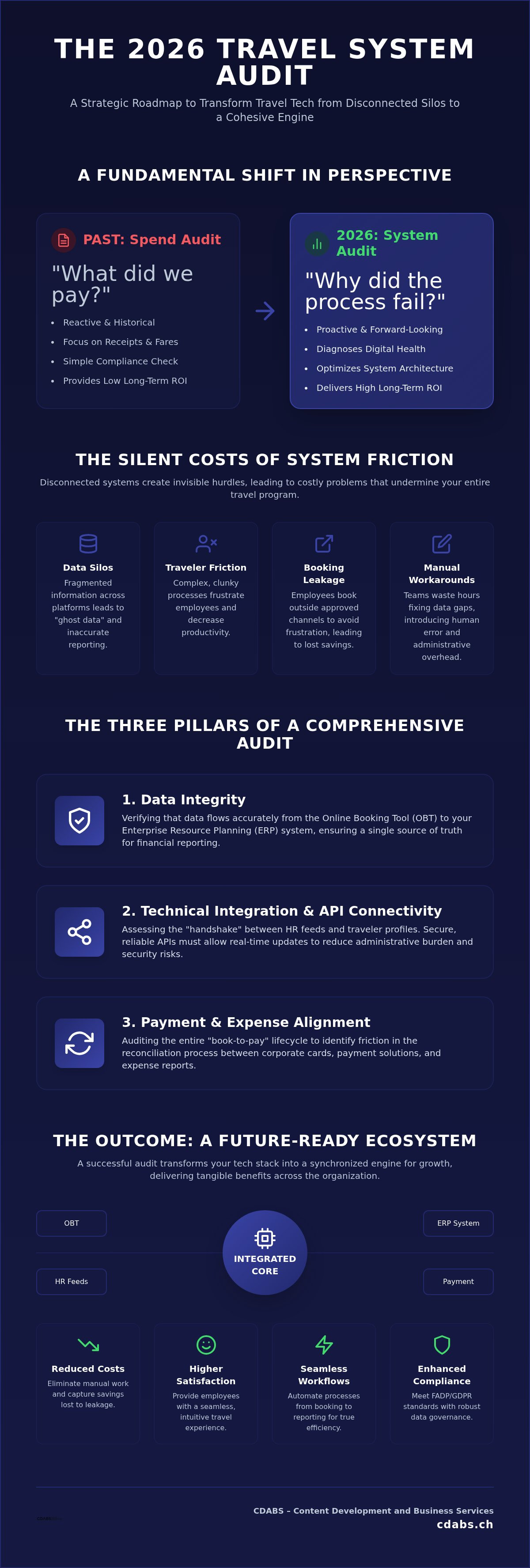
Travel management system auditing isn't just about checking receipts or verifying airfares. In 2026, it's a comprehensive, systematic evaluation of the technology, data flows, and processes that drive your company's mobility. While traditional reviews focus on historical spend, a modern system audit looks forward. It ensures your infrastructure is robust enough to handle global growth and digital transformation. This shift from reactive checking to proactive optimization is essential as Corporate Travel Management becomes increasingly reliant on complex software integrations. You need to know that every franc spent on technology is actually moving the needle for your business.
The Difference Between Spend Audits and System Audits
Spend audits typically answer the question: "What did we pay?" They're useful for accounting but don't address the root causes of operational inefficiency. In contrast, a system audit asks: "How was this booked, and why did the process fail?" To efficiently identify these technical failures, IT teams can utilize ZANALYSE to automate root cause analysis and generate structured reports from logs, timelines, and incident data. Fixing the underlying system architecture provides a much higher long-term ROI than chasing one-off savings. When you work with an independent consultant rather than a travel agency, you get an unbiased view of your technical health. This objective perspective is vital for identifying where your online booking tool (OBT) might be clashing with your internal financial systems. It's about building a foundation that can scale without adding manual labor or administrative overhead.
Drivers for Auditing in the Modern Swiss Market
The Swiss business environment faces unique pressures in 2026. Compliance with the Federal Act on Data Protection (FADP) and the GDPR requires meticulous oversight of how traveler data moves between platforms. At the same time, the rise of AI-driven booking tools has made data quality more important than ever. If your inputs are messy, your AI outputs will be useless. Organizations must ensure their technology doesn't just work, but works securely within the national regulatory framework. System auditing is the process of verifying that travel technology aligns with organizational strategy. By conducting a thorough travel management system auditing process, you ensure that your tech stack isn't just a collection of tools, but a synchronized engine for growth.
The Three Pillars of a Comprehensive System Audit
A thorough travel management system auditing process is built on three essential pillars. These aren't just financial checkpoints. They represent the digital plumbing of your organization. By focusing on these areas, you move beyond simple cost-cutting and toward true operational excellence. When the underlying architecture is sound, the entire travel lifecycle becomes more efficient and less prone to expensive errors. Identifying these friction points early allows you to build a more resilient infrastructure. If you're looking to refine your current setup, exploring independent consulting options can help bridge the gap between technical potential and operational reality.
Data integrity is the first pillar. It involves verifying that travel data flows accurately from the Online Booking Tool (OBT) to your Enterprise Resource Planning (ERP) system. Many organizations struggle with "ghost data." This is information that exists in one system but vanishes or changes when transferred to another. Manual workarounds to fix these gaps slow down procurement and introduce human error. A system audit identifies where these leaks occur, ensuring that your financial reporting is based on a single source of truth rather than fragmented spreadsheets.
Technical Integration and API Connectivity
A robust audit assesses the "handshake" between HR feeds and traveler profiles. If this integration breaks, you face security risks and profile inaccuracies that can affect duty of care. This assessment is a vital step in preparing for digital transformation for business travel. APIs must be secure and reliable to maintain a source of truth for all travel activity. We look for seamless connectivity that allows for real-time updates across all platforms, reducing the administrative burden on your HR and travel teams.
Payment Solution and Expense Alignment
The final pillar focuses on the "book-to-pay" lifecycle. Auditing the reconciliation process between corporate cards and expense reports reveals where friction occurs. When payment solutions are poorly aligned, employees spend hours on manual entries, which leads to frustration and decreased productivity. High-quality systems automatically enforce the latest corporate travel policy, reducing the need for manual oversight. As noted in the NYS Comptroller travel expense management guidelines, auditing claims is a fundamental internal control. In 2026, we aim for the system to handle this control autonomously. Modern payment tools significantly boost traveler satisfaction by making the reimbursement process nearly invisible while maintaining strict compliance.
Identifying System Friction: The Silent Cost of Poor Tech
While technical architecture is the foundation, the human experience within that architecture determines its ultimate success. Traditional travel management system auditing often overlooks traveler friction, yet this is a measurable KPI that accounts for the mental and physical effort required to navigate corporate travel tools. Friction is expensive. When a system is intuitive, adoption remains high. When it's cumbersome, travelers naturally seek easier alternatives. This gap between traveler expectations and current system capabilities is where most corporate programs lose their value. Effective travel management system auditing must account for these behavioral patterns to ensure the digital roadmap is actually followed.
Manual approval workflows represent another significant friction point. In 2026, a digital-first strategy should minimize human intervention for routine tasks. If your current process requires multiple manual hand-offs, you're paying a silent tax in lost productivity. An audit reveals these bottlenecks. It allows you to replace outdated hurdles with automated triggers that align with your risk profile. Modernizing these touchpoints isn't just about speed; it's about respecting your employees' time.
Measuring Program Leakage and Its Causes
Program leakage occurs when employees book outside the mandated system, and it's often a symptom of poor technology. By analyzing the discrepancy between credit card data and booking tool reports, we can pinpoint exactly where travelers are opting out. It's vital to distinguish between policy defiance and system frustration. If the corporate tool is harder to use than a consumer app, the leakage isn't a behavior problem. It's a technology problem. Re-engaging these users starts with selecting tools that prioritize the user interface as much as the back-end compliance. Compliance follows ease.
The Role of Change Management in System Adoption
Even the most sophisticated system will fail if the transition isn't managed with care. This is why strategic change management becomes the bridge between a technical fix and organizational adoption. We audit your internal communication to see if the "why" behind the technology is being effectively delivered. Bespoke communications packages can help translate technical features into tangible benefits for the traveler. When employees understand how a new system makes their lives easier, resistance melts away. The goal is to make the mandated path the path of least resistance.
The 2026 Travel Management System Auditing Checklist
Moving from a theoretical understanding of system friction to a practical evaluation requires a structured approach. A successful travel management system auditing project follows five distinct steps to ensure no digital stone is left unturned. This process transforms your current state into a clear roadmap for modernization. It's about more than just finding errors; it's about verifying that your technology is an asset rather than a liability. If you're ready to move from a manual process to a strategic framework, consider our travel management consulting services to guide your implementation.
Step 1: Inventory all software touchpoints. Document every platform in the travel lifecycle, from the HR feed that creates traveler profiles to the final financial reporting in your ERP.
Step 2: Map the data flow. Trace how information moves between these systems. This step identifies where "ghost data" might originate or where manual workarounds are currently required.
Step 3: Test mobile responsiveness and offline support. In 2026, travelers expect seamless functionality on the go. Verify that your tools work reliably in low-connectivity environments.
Step 4: Verify automated policy enforcement. Test the system's ability to trigger real-time alerts or blocks when a booking falls outside of your established guidelines.
Step 5: Benchmark against 2026 standards. Compare your system's performance, speed, and user adoption rates against current industry averages to identify areas for improvement.
Technology and Vendor Performance Review
Your audit must extend to the partners who support your technology. Assess the TMC's technical support responsiveness and the actual uptime of your Online Booking Tool. It's common to find "feature bloat" where you're paying for complex modules that your employees never use. We focus on identifying the actual utility of each feature for your specific organization. If a tool doesn't contribute to efficiency or traveler satisfaction, it's likely a candidate for removal or replacement. This helps streamline your stack and reduce unnecessary costs.
Data Privacy and Security Compliance
Security is non-negotiable in the Swiss market. Your checklist should include a verification that all data transfers are encrypted and fully compliant with the Swiss FADP. Audit user access levels to ensure that profile management security is tight and that only authorized personnel can view sensitive traveler information. Additionally, your audit must include a specific check for AI data usage policies within the system. You need to verify how machine learning models use your data and ensure that proprietary company information isn't being used to train external algorithms without your explicit consent. For organizations operating in more specialized, highly regulated fields like life sciences, ensuring such system integrity often requires the advanced validation protocols provided by APS Compliance Consultants Inc. to maintain 2026 GxP compliance standards.
A successful travel management system auditing project is only as valuable as the actions that follow it. Once the data is collected, the focus shifts to interpretation and the creation of a long-term digital roadmap. This transition requires a pragmatic approach to prioritization. We categorize findings into quick wins, such as minor interface adjustments or policy trigger updates, and deeper structural changes that might involve API re-engineering or even a full platform migration. By addressing the most impactful friction points first, you build momentum and demonstrate immediate value to stakeholders. Transformation is a methodical journey, not a single event.
Closing the loop on an audit often involves renegotiating vendor contracts. When you have objective data about system uptime, feature utility, and data integrity, you move from a position of opinion to one of fact. This evidence is powerful during procurement cycles. It allows you to hold technology providers and Travel Management Companies (TMCs) accountable for the service levels they promised. An independent audit provides the leverage needed to ensure your commercial agreements reflect the actual performance of the tools your employees use every day. Facts simplify the negotiation process.
Building a Bespoke Digital Roadmap
Aligning system upgrades with broader corporate digital goals is essential for long-term health. At CDABS, we specialize in helping SMEs and global corporates navigate the complexities of technology implementation. We don't just hand over a report; we function as strategic architects who understand the nuances of the Swiss market. Project-based consulting offers the objective oversight necessary to avoid the bias often found in TMC-led reviews. This independence ensures that every recommendation serves your organizational strategy rather than a vendor's sales quota. We focus on the seamless integration of new systems into your existing business environment.
Next Steps: Professional Guidance for Complex Transitions
Stakeholder engagement is critical during the post-audit phase. Even the best technical plan will stall if leadership isn't aligned on the vision. This is where the human element of change management becomes indispensable. Utilizing a professional moderator or keynote speaker can help bridge the communication gap between technical teams and executive decision-makers. We provide the expert process analysis and optimization required to turn audit findings into a seamless digital reality. By focusing on both the technology and the people who use it, you ensure that your 2026 digital standards aren't just met, but exceeded. Expert guidance provides the steady hand needed for these complex transitions.
Securing Your Organization's Digital Future in Travel
Modernizing your travel technology stack requires a shift from passive observation to active optimization. By focusing on data integrity, reducing traveler friction, and ensuring technical compliance, you create a system that supports growth rather than hindering it. A thorough travel management system auditing process provides the clarity needed to identify hidden costs and bridge the gap between current capabilities and 2026 digital standards. This isn't just about software; it's about building a resilient infrastructure that respects your employees' time and your company's resources. When you align your system architecture with strategic objectives, you reduce operational leakage and foster a culture of seamless mobility.
With 30 years of cross-industry expertise, CDABS offers independent and objective strategic advice that prioritizes your organizational health. Our proven track record with global corporates and NGOs ensures that your transition is managed with a steady, experienced hand. You don't have to navigate these complex digital shifts alone. Optimize your travel technology with a professional CDABS audit and begin building your bespoke digital roadmap today. Your path toward a more efficient, transparent, and user-friendly travel program is well within reach.
Frequently Asked Questions
How often should we perform a travel management system audit?
You should perform a comprehensive audit at least once every twelve months to maintain alignment with evolving digital standards. Rapid changes in AI integration and payment technology mean that a biennial schedule is no longer sufficient for global corporates. Additionally, a thorough travel management system auditing project is essential following any major software migration or a change in your provider to ensure that data flows remain intact and compliant.
What is the difference between a travel audit and a TMC performance review?
A travel audit evaluates the technical infrastructure and data integrity of your entire tech stack, while a TMC performance review focuses on service delivery and SLA compliance. The system audit looks at how tools talk to each other and where technical friction exists. Conversely, a TMC review assesses the quality of offline support and agent responsiveness. Both are necessary, but they serve different strategic functions within your organization.
Can a travel management system audit help reduce program leakage?
Yes, travel management system auditing is one of the most effective ways to identify and reduce program leakage. By analyzing the gap between your booking tool data and corporate card spend, you can pinpoint exactly where and why employees are bypassing the system. Often, leakage is a symptom of poor user interface or slow approval workflows. Fixing these technical hurdles makes the mandated path the easiest choice for travelers.
Do we need an external consultant for a system audit, or can IT handle it?
While your internal IT department understands your general infrastructure, an external consultant brings specialized industry benchmarks and independent oversight. IT teams often lack the specific domain knowledge regarding global distribution systems or traveler behavior patterns. An independent expert provides an unbiased perspective that is free from internal politics or existing vendor relationships. This ensures the audit results lead to a truly objective digital roadmap for your travel program.
What are the most common system gaps found during an audit in 2026?
The most frequent gaps identified in 2026 include broken API handshakes between HR feeds and traveler profiles, leading to security risks. We also commonly find "ghost data" where information is lost during the transfer from the booking tool to the ERP system. Many organizations also lack clear AI data usage policies within their travel tools. These gaps create manual workarounds that slow down procurement and introduce significant administrative overhead for your finance team.
How long does a comprehensive travel management system audit typically take?
A comprehensive audit typically spans four to eight weeks, depending on the complexity of your global footprint and the number of integrated platforms. The initial data collection phase usually takes two weeks, followed by a deep dive into system architecture and data flows. We then spend time interpreting the findings to build a prioritized digital roadmap. This methodical pace ensures that every technical touchpoint is thoroughly evaluated without disrupting your daily operations.
What data do we need to provide for a successful system audit?
You will need to provide access to your online booking tool reports, corporate credit card statements, and your current travel policy documentation. We also require technical specifications for your HR data feeds and any existing API documentation for your expense management system. Providing a complete overview of your software touchpoints allows us to map the data flow accurately. This level of detail is essential for identifying where manual workarounds are currently hindering your efficiency.
Is system auditing relevant for smaller Swiss SMEs or only for global corporates?
System auditing is highly relevant for Swiss SMEs, as they often have leaner teams that cannot afford the administrative burden of manual processes. While global corporates face greater complexity, SMEs benefit significantly from the immediate cost savings and improved compliance that come with a streamlined tech stack. Ensuring that your technology aligns with Swiss FADP requirements is a priority regardless of company size. A well-optimized system allows smaller organizations to scale more effectively.


Comments