
Travel Management Software Selection: A Strategic 2026 Buyer’s Guide
Updated: Aug 31
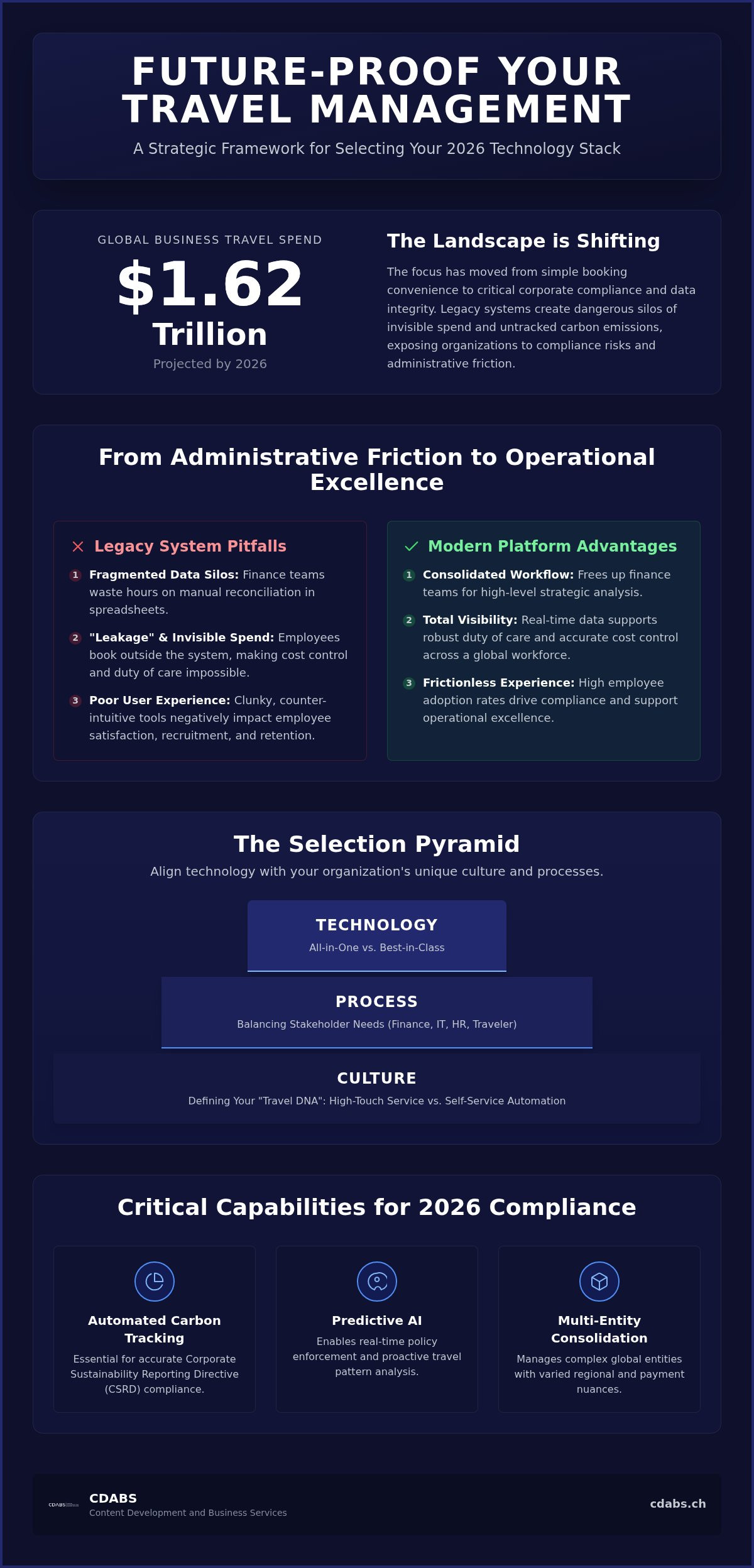
Could your current travel technology withstand the scrutiny of a 2026 ESG audit? With global business travel spend projected to reach 1.62 trillion dollars, the stakes for travel management software selection have shifted from simple booking convenience to critical corporate compliance and data integrity. Many organisations find themselves trapped between fragmented legacy systems and tools that employees simply refuse to use, creating dangerous silos of invisible spend and untracked carbon emissions.
It's a frustrating reality that many decision-makers face, where the promise of digitisation often results in more administrative friction rather than less. We understand that you need a solution that balances user experience with the rigorous demands of multi-entity consolidation and CSRD reporting. This strategic guide offers an independent, expert-led framework to help you master these complexities and secure a future-proof technology stack. We'll examine the essential criteria for selecting a platform that handles AI integration and real-time ESG data, providing you with a clear path toward a truly consolidated travel and expense workflow. By focusing on operational excellence and strategic growth, you can transform your travel programme into a seamless digital backbone for your entire organisation.
Table of Contents
The 2026 Landscape: Why Travel Management Software Selection is Evolving
Global business travel spend is on track to hit 1.62 trillion dollars by 2026. This volume isn't just a recovery; it's a fundamental shift in how companies move their people across borders. Traditional Corporate travel management once focused almost exclusively on the booking transaction. Today, the focus has shifted toward integrated ecosystems that prioritise data integrity and user experience. Your travel management software selection process must now account for how these tools communicate with HRIS, ERP, and ESG reporting platforms. Legacy systems often buckle under this weight, exposing cracks in data accuracy that were previously ignored during lower volume periods.
Travel is no longer a back-office expense to be minimised. It's a core component of organizational health and employee satisfaction. Modern professionals expect "frictionless travel" as a standard part of their employment package. If your tools are clunky or counter-intuitive, you'll see a direct impact on recruitment and retention. Consequently, the role of the Travel Manager has evolved. They've become Strategic Transformation Leads who bridge the gap between procurement, finance, and human resources. These leaders focus on the seamless integration of new systems to ensure that travel supports, rather than hinders, operational excellence.
The Cost of Administrative Friction
Fragmented processes carry heavy, hidden operational costs that go far beyond the price of a plane ticket. When data sits in silos, finance teams spend valuable hours on manual reconciliation. A finance team stuck in spreadsheets is a team that cannot focus on high-level strategic analysis. Poor technology also drives "leakage" spend. When employees find internal tools difficult to use, they book outside the system using consumer sites. This creates a lack of visibility that makes duty of care and cost control nearly impossible to maintain across a global workforce.
Modernisation as a Strategic Imperative
Implementing a robust digital transformation for business travel is the foundation for growth in 2026. It's about agility and the ability to respond to market shifts. A well-chosen platform allows for multi-entity consolidation and real-time adjustments to travel policy. Before you sit through vendor demos, you need a clear digital roadmap. Your travel management software selection should only begin once you've defined your strategic objectives. This methodical approach prevents the common pitfall of being swayed by flashy features that don't align with your core operational needs.
A Strategic Framework for Software Selection
Successful travel management software selection is less about buying a product and more about designing a digital architecture. We start by defining your "Travel DNA". This process assesses your current operational maturity against your 2026 goals. A firm with five offices has different DNA than a global NGO with five hundred. You must decide if your organisation thrives on high-touch service or if a lean, automated, self-service model fits your culture better.
We advocate for a "Selection Pyramid" where technology sits at the very top. The foundation is culture, followed by process. If the software doesn't align with how your people work, even the most advanced AI features won't save the implementation. You also need a comprehensive stakeholder map to ensure buy-in across the board. Finance requires granular data for tax compliance. IT requires seamless API connections to your existing ERP. HR focuses on duty of care and traveller safety. The frequent traveller simply wants a mobile experience that works without friction. Balancing these competing needs requires a steady hand and a clear vision.
For complex global entities, the "All-in-One" promise is often a mirage. These suites frequently lack the depth needed for multi-entity consolidation or specific regional payment nuances. A "Best-in-Class" approach allows you to integrate the best booking tool with the best expense management software. This modularity ensures your technology stack remains agile as new AI capabilities emerge. Choosing the right components allows for a more tailored fit that can grow alongside your business. If you need help navigating these choices, our strategic consulting services provide the independent oversight needed for such a transition.
Aligning Technology with Corporate Culture
A tool that forces a rigid, one-size-fits-all policy onto a flexible corporate culture will fail. You need to evaluate whether a platform supports your specific governance needs while reflecting your brand's commitment to employee experience. This is where a corporate travel transformation advisor becomes essential. They act as a bridge between technical IT requirements and the lived experience of the user, ensuring the software feels like a benefit rather than a burden.
The Audit: Finding Your System Gaps
Before looking at vendor demos, you must understand your current shortcomings. A thorough travel management system auditing process reveals "data black holes" where spend or carbon emissions go untracked. You need to determine if your provider can scale with your 2026 growth plans. If you find your current reporting is consistently delayed or inaccurate, it's a clear signal for change. Identifying these gaps early prevents costly mistakes during the final implementation phase.
Critical 2026 Capabilities: AI, ESG, and Payments
As we approach 2026, the criteria for travel management software selection have narrowed to three non-negotiable pillars: intelligence, accountability, and financial agility. For organisations operating across multiple borders, particularly those navigating the complexities of the Swiss market and global NGO sectors, the ability to handle diverse currencies and tax jurisdictions seamlessly is paramount. It isn't just about converting Swiss Francs to Euros; it's about real-time expense reconciliation and the deployment of virtual cards that offer granular control over spend. These payment systems must integrate directly into your digital backbone to eliminate the manual data entry that currently plagues finance departments.
Multi-entity support is where many generic solutions fail. A truly capable platform manages local tax regulations and reporting requirements without requiring constant manual intervention. This level of automation ensures that your global travel programme remains compliant while providing the visibility needed for accurate forecasting. When your software handles these intricacies, your team can focus on strategic growth rather than administrative troubleshooting.
AI as the Baseline for Compliance
Just as corporate travel requires a robust digital backbone for efficiency, industrial sectors depend on specialized expertise to modernize their operations. Ana-Digi Systems offers this support through industrial automation and energy optimisation, helping businesses achieve similar levels of operational agility and ESG compliance.
AI has moved beyond the gimmick of simple chatbots. In the current environment, it serves as a silent guardian for policy enforcement. Modern systems use predictive analytics to identify out-of-policy spend before a booking is ever confirmed. This proactive approach saves thousands in potential leakage and provides the data necessary to negotiate better rates with preferred suppliers. However, you must be wary of vendor marketing. Many claim to have advanced AI that is little more than a set of basic rules. We help you look under the hood to verify what's real and what's simply a sales pitch during the travel management software selection process.
The Sustainability Mandate
Sustainability is no longer a discretionary feature. With CSRD and specific Swiss regulatory requirements for emissions reporting, automated carbon tracking at the point of sale is essential. Your software should provide travellers with clear data on the environmental impact of their choices, allowing them to opt for greener alternatives in real-time. This isn't just about compliance; it's about driving a meaningful "Green ROI". By integrating these choices into the booking workflow, you align your corporate travel with your broader environmental goals, turning abstract CSR targets into measurable results. For companies seeking to extend these sustainability efforts into other operational areas like textiles, you can visit Symolem to learn about their specialized advisory on circularity and climate policy.
A successful travel management software selection follows a rigorous, five-phase lifecycle that transitions from internal discovery to global deployment. This systematic approach ensures that the chosen solution isn't just a technical upgrade but a strategic asset. Phase 1 begins with a deep needs analysis and the development of a robust business case. You must define what success looks like in quantifiable terms, such as a 20% reduction in manual reconciliation time or a 15% increase in policy compliance. Without these benchmarks, your selection remains subjective and vulnerable to vendor influence.
The Strategic RFP
Phase 2 involves the Request for Proposal (RFP). This document shouldn't just be a list of features; it should be a diagnostic tool designed to ask the questions vendors often prefer to avoid. You need to focus on integration capabilities and data portability. Ask how the vendor handles data migration if you decide to switch providers in three years. Evaluate their long-term product roadmap and financial stability to ensure they'll remain a viable partner through 2026 and beyond. Finally, define clear KPIs for the system's first 12 months to hold the provider accountable for the promised outcomes.
Once you've narrowed the field, Phase 3 moves into the Proof of Concept (PoC) and User Acceptance Testing. This is where you test the software against your real-world workflows. Phase 4 focuses on contract negotiation. Don't just look at the subscription fee. Scrutinise implementation costs, API access fees, and support tiers. Only after these details are secured can you move to Phase 5: Mastering business travel technology implementation. This final step transforms your selection into a functioning reality across your global entities.
Change Management and Communication
Technology often fails not because of the software itself, but because of a lack of human buy-in. This is why your selection must be paired with a comprehensive change management for corporate travel strategy. You need to develop bespoke communication packages that explain the "why" behind the shift to your employees. High adoption rates are only possible when travellers understand how the new tool makes their lives easier. Securing executive buy-in from the start ensures that the project has the necessary resources and authority to overcome internal resistance during the rollout.
If you are ready to begin this transition with an expert hand, our business travel management consulting provides the independent oversight needed to navigate these complex phases. We ensure your travel management software selection is driven by data and aligned with your long-term organisational health.
Why Independent Advisory is the Final Selection Step
The final hurdle in any travel management software selection is the removal of bias. Many organisations don't realise that travel management companies often have commercial incentives to recommend specific software platforms. This "hidden" agency bias can lead you toward a tool that suits the vendor's bottom line rather than your own operational requirements. An independent advisor acts as a steady, experienced hand throughout the travel management software selection process. We provide a calm, controlled perspective on complex transitions, ensuring that your final choice is based on data and strategic fit.
By partnering with a consultant, you move from being a simple software buyer to becoming a strategic travel leader. You gain the ability to oversee the entire project lifecycle, from the initial needs analysis to the final delivery of a consolidated workflow. This oversight is what prevents the common pitfalls of vendor lock-in. It allows your organisation to remain agile, ready to integrate new AI developments or payment systems as they emerge without being tethered to a single, rigid provider.
Leveraging 30 Years of Industry Expertise
CDABS brings over 30 years of industry experience to your project. We've navigated diverse challenges across SMEs, NGOs, and global corporates. Our role is that of a strategic architect and a hands-on facilitator. We understand the nuances of global travel management solutions and the high standards of Swiss operational excellence. This expertise allows us to bridge the gap between local needs and global scale, ensuring that your implementation is both thorough and methodical. We don't just suggest a tool; we manage the digital shift to ensure it aligns with your broader business cycles.
Your Next Steps in the Selection Journey
Your journey toward a modern travel ecosystem shouldn't start with a vendor demo. It starts with a clear understanding of your current system gaps. Define your immediate priorities for the coming quarter and conduct a preliminary process analysis. This foundation ensures that when you do enter the RFP phase, you're asking the right questions. If you're ready to master the complexities of modern travel technology with a dedicated partner, now is the time to act. Book a strategic consultation with CDABS to begin your transformation today.
Securing Your Organisation's Digital Future in Business Travel
The landscape of 2026 requires more than just a booking tool; it demands a strategic digital backbone that ensures ESG compliance and operational agility. Successful travel management software selection hinges on a methodical framework that prioritises your internal culture and processes before committing to a technical vendor. By focusing on multi-entity consolidation and frictionless user experiences, you can transform a fragmented system into a source of organizational health and employee satisfaction.
Executing this transition requires a steady hand with deep industry knowledge. CDABS provides 30+ years of global business travel expertise as a fully independent, vendor-neutral advisor. We specialise in Swiss-based global corporate transformations, providing the strategic oversight needed to bridge the gap between complex technology and real-world adoption. Our approach ensures that your new systems are integrated seamlessly while maintaining a focus on long-term growth and operational excellence.
Partner with CDABS for your strategic software selection to secure a future-proof travel programme. Taking the first step toward modernisation today ensures your organisation remains resilient and ready for the challenges of tomorrow.
Frequently Asked Questions
How long does the travel management software selection process typically take?
A thorough travel management software selection process typically spans three to six months. This timeframe allows for a methodical approach, starting with a deep needs analysis and moving through the RFP and Proof of Concept phases. Global corporates with multi-entity needs require this duration to ensure all stakeholders are aligned. Rushing this cycle often leads to poor implementation and technical debt that costs more to fix later.
What are the most common mistakes companies make when choosing travel tech?
The most frequent error is prioritising flashy software features over core business processes. Many firms fail to map their internal "Travel DNA" or neglect to involve key stakeholders like Finance and IT early enough. Another mistake is being swayed by vendor marketing without verifying technical claims through a Proof of Concept. This often results in a tool that fails to handle the reality of global tax jurisdictions.
How does travel software help with CSRD and ESG reporting?
Modern platforms provide automated carbon tracking at the point of sale, which is essential for meeting CSRD and Swiss regulatory requirements. Instead of manual data collection, these tools capture emissions data for every flight, hotel, and rail booking in real-time. This visibility allows organisations to report accurately on their environmental impact and drive a meaningful "Green ROI" by encouraging travellers to choose lower-carbon alternatives within the workflow.
Do I need a consultant if I already have a Travel Management Company (TMC)?
Yes, because a consultant provides an independent, vendor-neutral perspective that a TMC often cannot. While your TMC manages bookings, they may have commercial incentives to recommend specific technology stacks. An independent advisor focuses solely on your organisational health and strategic goals. We help you navigate the market without the "hidden" agency bias, ensuring your travel management software selection is driven by your specific needs rather than commissions.
What is the difference between an Online Booking Tool (OBT) and an end-to-end Travel Management Platform?
An Online Booking Tool (OBT) is primarily a transaction engine for reserving flights and hotels. In contrast, an end-to-end platform functions as a digital backbone that integrates booking, expense management, and real-time data reporting. These comprehensive systems communicate directly with your HRIS and ERP, providing a consolidated workflow. For global entities, the latter is essential for maintaining data integrity and ensuring seamless multi-entity consolidation across diverse currencies.
How do I ensure high employee adoption of a new travel tool?
High adoption starts with selecting a tool that offers a frictionless, consumer-grade user experience. However, technology alone isn't enough. You must implement a strategic change management plan that explains the benefit to the individual traveller. Bespoke communication packages help bridge the gap between the new technical requirements and the employee's daily reality. When staff understand how the tool simplifies their workflow, they are far more likely to remain compliant.
Can travel management software integrate with my existing ERP and HR systems?
Yes, integration via modern APIs is a non-negotiable requirement for 2026. Your travel software should feed data directly into your HR systems for profile management and into your ERP for real-time expense reconciliation. This connectivity eliminates the administrative friction caused by manual data entry and fragmented silos. During the selection process, we rigorously vet a vendor's integration capabilities to ensure the new tool becomes a seamless part of your stack.
What should I look for in a vendor’s AI capabilities in 2026?
Look beyond simple chatbots and focus on predictive policy enforcement. In 2026, effective AI should identify out-of-policy spend and potential safety risks before a booking is confirmed. It should also provide predictive analytics to help you negotiate better rates with preferred suppliers based on future travel patterns. Always ask for a technical deep dive during the travel management software selection to verify that the AI is a functional tool.


Comments