
The Strategic Role of a Change Communication Consultant for Travel Technology
Updated: Sep 1
What if the primary barrier to your digital transformation isn't the software itself, but the silence that follows its implementation? Many Swiss organisations invest hundreds of thousands of CHF into sophisticated Online Booking Tools (OBTs), only to find that employees continue to bypass the system in favour of traditional methods. Engaging a change communication consultant for travel technology addresses this disconnect by focusing on the human element of the transition. It's a frustrating scenario where expensive technology sits idle while operational costs climb, yet it's entirely avoidable with the right strategic oversight.
You'll discover how a specialised expert bridges the gap between technical implementation and enthusiastic adoption to secure your return on investment. We'll explore the methodical process of managing stakeholder friction and crafting bespoke messaging that resonates with every level of the business. This guide provides a clear path toward transforming a complex system transition into a seamless evolution that drives efficiency and long-term organisational health. By moving beyond simple announcements, you can ensure your travel technology becomes a catalyst for growth rather than a source of frustration.
Table of Contents
Why Travel Technology Implementation Fails Without Strategic Change Communication
The Strategic Role of a Change Communication Consultant in Travel Tech
Consultant vs. Software Vendor: Why Independent Oversight Matters
Building a Change Communication Framework for Travel Technology
CDABS: Bespoke Change Communication Packages for Travel Transformation
Why Travel Technology Implementation Fails Without Strategic Change Communication
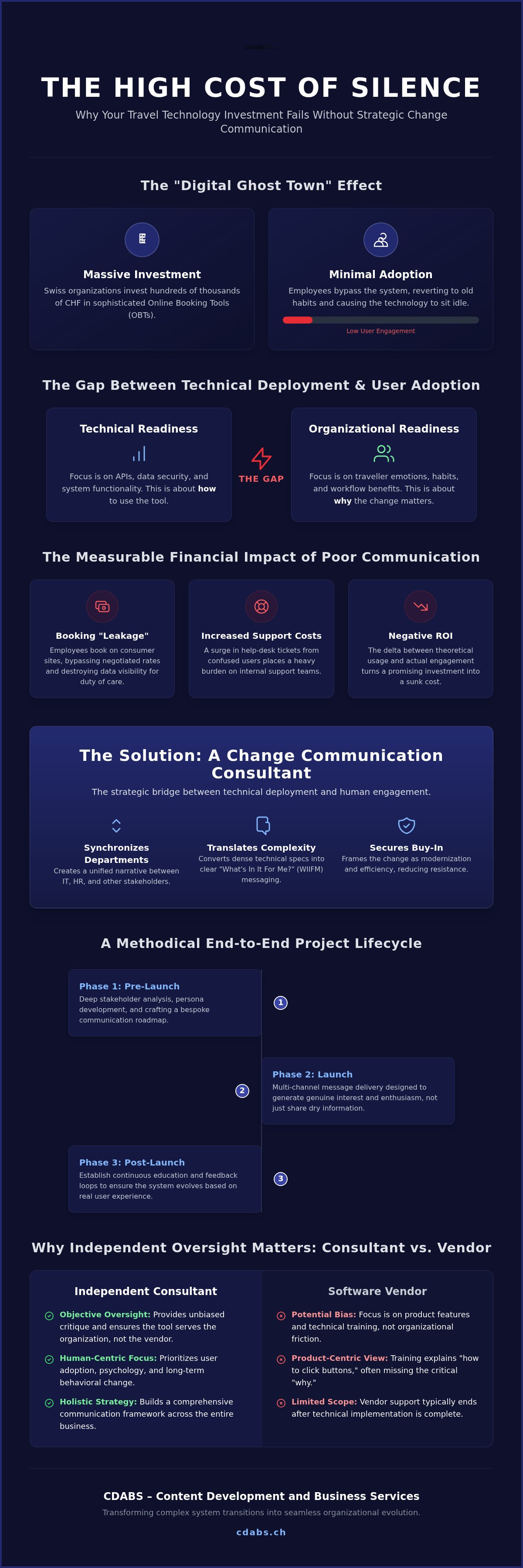
The belief that superior software naturally attracts users is perhaps the most pervasive myth in corporate digital transformation. In the Swiss market, where precision and reliability are paramount, organisations often invest hundreds of thousands of CHF in sophisticated Online Booking Tools (OBTs) only to face a "ghost town" effect. Without a dedicated change management strategy, the transition from high-touch agency support to self-service technology feels like a loss of service rather than a gain in efficiency. Employees often harbour anxiety about making mistakes in a live booking environment or simply revert to old habits because the new interface seems too complex. When users don't understand the "why" behind a new tool, they'll find any excuse to avoid using it.
The Gap Between Technical Deployment and User Adoption
Technical readiness is not the same as organisational readiness. While IT departments focus on API integrations and data security, they frequently overlook the traveller's emotional and practical journey. This oversight leads to a significant "adoption dip" within the first 90 days of a launch. During this window, frustration peaks and users are most likely to abandon the system. A change communication consultant for travel technology bridges this gap by shifting the focus from technical training to psychological persuasion. Training tells people how to click buttons; persuasion explains why the change benefits their daily workflow and ensures they feel supported through the initial learning curve. It's about moving from a forced mandate to a shared vision of modernization.
The Financial Impact of Poor Communication
The cost of silence is measurable in Swiss Francs. When travellers find a tool unintuitive or intimidating, they engage in "leakage," booking flights and hotels through consumer sites instead of the mandated platform. This bypasses corporate negotiated rates and destroys the data visibility required for duty of care. Poorly communicated rollouts also trigger a surge in help-desk tickets, placing an unnecessary burden on internal support teams. By engaging a change communication consultant for travel technology, businesses can mitigate these risks and streamline the transition process. Clear, consistent messaging reduces support costs and ensures that travellers remain within the managed programme.
Change Communication ROI is the delta between theoretical system usage and actual user engagement. Reducing this gap ensures that your travel tech investment delivers the promised savings rather than becoming a sunk cost. A methodical approach to communication isn't just a "nice to have"; it's a financial imperative for any business serious about digital transformation.
The Strategic Role of a Change Communication Consultant in Travel Tech
A change communication consultant for travel technology acts as the essential connective tissue between technical deployment and human engagement. While an IT team ensures the software functions and HR manages general policy, the consultant synchronises these departments to create a unified narrative. They translate dense technical specifications into "What is in it for me?" (WIIFM) messaging that resonates with the individual traveller. Instead of presenting a new Online Booking Tool as a cost-cutting measure, which often triggers employee resistance, the consultant frames it as a step toward modernisation and personal efficiency. This shift in perspective is vital for securing executive buy-in and reducing friction across the organisation. They serve as a strategic architect, ensuring the human element isn't lost in the technical noise.
End-to-End Oversight of the Project Lifecycle
Successful implementation requires a methodical approach that spans the entire project lifecycle. During the pre-launch phase, the consultant conducts deep stakeholder analysis and develops a communication roadmap tailored to the specific needs of different departments. The launch phase involves multi-channel delivery designed to generate genuine interest rather than just providing dry information. Finally, the post-launch phase focuses on continuous education and feedback loops. This ensures the system evolves based on actual user experience. This structured flow prevents the common mistake of "launch and leave," providing a sense of stability throughout the transition. It's about maintaining momentum long after the initial go-live date.
The Value of Seasoned Professional Experience
Navigating the complex ecosystem of OBTs, Travel Management Companies (TMCs), and payment solutions requires more than just a template. With over 30 years of industry experience, a consultant offers a steady hand that has seen almost every potential pitfall in the corporate travel sector. This seasoned authority is particularly valuable during high-pressure transitions where technical glitches or employee pushback can derail a project. By providing bespoke change management communications packages, a consultant ensures the strategy is as unique as the organisation itself. They act as a hands-on facilitator, ensuring broader strategic objectives are met while managing the intricate details of daily operations. This level of dedicated oversight is often the difference between a fragmented rollout and a cohesive, successful digital transformation.
Consultant vs. Software Vendor: Why Independent Oversight Matters
Choosing between a software vendor's support team and an independent change communication consultant for travel technology is often the difference between a surface-level launch and deep-rooted adoption. Vendors have a natural bias. Their primary objective is the technical deployment of their specific product, not necessarily the cultural integration within your company. While they might provide a library of generic "how-to" videos, they rarely have the mandate or the insight to critique how their tool fits into your unique workflow. Independent oversight ensures the project remains focused on the client's return on investment rather than the vendor's feature list.
Internal teams often face a different challenge: the capacity gap. While your travel manager or HR lead understands the business, they may lack the specific expertise required to manage a complex digital transformation alongside their daily responsibilities. An external expert brings a fresh, objective perspective. This independence serves as a powerful tool for honest stakeholder engagement. It allows for difficult conversations that internal staff might avoid, such as addressing executive resistance or identifying why a previous implementation failed. A consultant acts as a steady hand, navigating these internal politics with the quiet confidence of a seasoned professional.
Objectivity in Travel Management System Auditing
An independent consultant identifies gaps that a vendor might overlook or choose to ignore. During the execution of a digital roadmap, the consultant protects the client's interests by ensuring the tech provider meets all functional requirements before the "go-live" date. They act as a neutral mediator, translating corporate needs into technical requests and vice versa. This objective auditing prevents the common mistake of accepting a "workaround" that eventually leads to user frustration and system abandonment. By maintaining this professional distance, the consultant ensures the technology serves the business, not the other way around.
Customisation vs. Standard Templates
Generic templates from software providers frequently fail because they don't speak the language of your organisation. A "one size fits all" guide cannot account for the specific cultural nuances of a Swiss SME or a global NGO. Bespoke communications packages replace these dry manuals with messaging that aligns with your corporate values and strategic goals. This approach integrates travel technology communications into the broader organisational health strategy. Instead of a disconnected IT update, the rollout becomes a meaningful part of the company's evolution. Personalised messaging acknowledges the traveller's pain points and offers concrete solutions, which is essential for overcoming old habits and fostering genuine system loyalty.
Building a Change Communication Framework for Travel Technology
A successful digital transition doesn't happen by accident. It requires a methodical, four-step framework that moves from initial analysis to final delivery. Engaging a change communication consultant for travel technology allows you to move beyond generic announcements and create a structured roadmap. This process begins with comprehensive stakeholder mapping to identify every department touched by the new system. Once you understand the audience, you can define strategic objectives and craft messaging that speaks directly to their concerns. Execution then moves across multiple channels, including Slack, internal townhalls, and targeted email campaigns; here, leveraging professional video production from specialists like Digital Content Studios can significantly boost engagement, followed by a rigorous feedback loop to ensure continuous improvement.
Persona-Based Messaging for Maximum Impact
Effective communication requires a deep understanding of different organisational roles. For the C-Suite, the narrative should focus on risk management, ESG (Environmental, Social, and Governance) goals, and overall bottom-line efficiency. Finance and procurement teams require a different approach, where the emphasis shifts to data transparency and the seamless integration of new payment solutions. Meanwhile, frequent travellers are primarily concerned with reducing friction in their booking process and maintaining high levels of mobile engagement. Tailoring the message ensures that every stakeholder sees the personal value in the new technology, which is essential for securing long-term adoption.
Overcoming Resistance through Strategic Narrative
Resistance is a natural part of any organisational shift, often manifesting as the belief that "the old way was easier." To counter this, a change communication consultant for travel technology identifies internal "champions" who can provide social proof of the tool's benefits. These early adopters help normalise the new system and provide peer-to-peer support that feels more authentic than a top-down mandate. Internal communication strategies for change must prioritise empathy over technical instruction. By acknowledging the learning curve and providing a steady hand through the transition, you build trust and reduce the psychological barriers to entry.
If you're ready to move beyond technical manuals and drive real engagement, consider how bespoke change management communications packages can transform your next rollout. A structured approach ensures your travel technology becomes a catalyst for efficiency rather than a source of internal friction.
CDABS: Bespoke Change Communication Packages for Travel Transformation
CDABS represents a unique intersection of strategic consulting and hands-on facilitation. Led by Dominic Short, the firm leverages a 30-year legacy in the Swiss business travel sector to provide a steady hand for complex transitions. Unlike large-scale human capital firms that offer broad, generic advice, CDABS functions as a specialised change communication consultant for travel technology. This focus allows for a deep understanding of the specific logistics and technical requirements inherent in travel management. Whether you're an SME, an NGO, or a global corporate entity, the approach remains methodical and results-oriented, ensuring that your digital transformation isn't just a technical success but a cultural one too.
The service goes beyond simple messaging. It integrates tech transformation with broader operational needs, including meeting and conference organisation. This holistic view ensures that every aspect of your travel programme is aligned with your strategic objectives. Engaging a change communication consultant for travel technology who understands the nuances of the local market provides a significant competitive advantage. By combining architectural strategy with personal facilitation, CDABS ensures that the human element of change is never overlooked.
Bespoke Solutions for Organizational Excellence
Every organisation carries its own set of challenges and cultural nuances. CDABS develops tailored roadmaps that address these specificities directly. This synergy between travel management consulting and change communications ensures that the technical roadmap and the human roadmap move in lockstep. Instead of a "one size fits all" approach, you receive a bespoke package designed for your specific project lifecycle. This level of precision is essential for maintaining organisational health during periods of significant shift. If you're planning an upcoming system launch, you can contact CDABS for a consultation to ensure your strategy is robust from day one.
Beyond Communication: A Holistic Strategic Partnership
A successful rollout doesn't end with a launch announcement. CDABS offers a holistic partnership that links travel policy development directly with communication strategies. This ensures that the rules of the programme are communicated with empathy and clarity, reducing friction and increasing compliance. Continuous education is a cornerstone of this approach, offered through masterclasses and executive training sessions. These programmes empower your internal teams to manage the new system with confidence and authority. This steady, professional guidance helps navigate the complexities of modern travel tech while keeping the focus on long-term growth.
By choosing an expert who understands the Swiss market's unique demands, you secure a partner dedicated to your success. It's time to bridge the gap between investment and adoption. Partner with CDABS for your next travel technology transformation to ensure your ROI is protected by a seasoned professional who understands the intricate details of your business.
Securing the Future of Your Digital Travel Ecosystem
A successful digital transformation in the travel sector requires more than just technical precision; it demands a deep commitment to the human element of change. We have explored how independent oversight prevents the common pitfalls of vendor bias and how a structured, persona-based framework ensures that every employee understands the personal value of new systems. By prioritising empathy and clear narrative over dry technical instruction, organisations can effectively bridge the gap between software implementation and widespread user adoption. It isn't enough to simply launch a tool; you must also inspire the people who use it.
Engaging a change communication consultant for travel technology provides the steady hand needed to navigate these complex transitions with confidence. With over 30 years of industry experience, CDABS offers independent and objective strategic advice tailored specifically to Swiss national market requirements. This methodical approach protects your investment and ensures long-term organisational health. You can secure your travel technology ROI with CDABS bespoke consulting and transform your next rollout into a seamless evolution. Your technology has the potential to drive significant growth, and with the right strategic partner, your team will be ready to embrace it.
Frequently Asked Questions
What does a change communication consultant for travel technology actually do?
A consultant acts as the strategic architect between technical deployment and user adoption. They create tailored roadmaps, stakeholder personas, and multi-channel messaging to ensure the purpose of the change is understood. This involves managing the project lifecycle from pre-launch hype to post-launch feedback loops. They ensure the human element remains a priority amidst complex IT integrations, ensuring technical readiness meets organisational readiness for a smooth transition.
Why can’t our internal HR or IT team handle the communication for new travel tech?
Internal teams often lack the specific niche expertise in travel logistics and are already stretched thin by daily operations. IT focuses on technical specs, while HR handles general policy. Neither usually has the 30 years of experience needed to navigate the unique friction points of corporate travel. An external expert provides an objective perspective, allowing for honest stakeholder engagement that internal politics might otherwise hinder.
How early in the technology implementation process should a consultant be involved?
Engagement should ideally begin during the software selection phase or at least three to four months before the scheduled "go-live" date. Early involvement allows for comprehensive stakeholder mapping and the development of a proactive narrative. Starting late often results in a reactive strategy that struggles to overcome established resistance. A steady hand at the beginning prevents the "adoption dip" that typically occurs in the first 90 days.
What are the most common mistakes in travel technology communication?
Relying on generic vendor templates and a "one size fits all" announcement are the most frequent errors. Many organisations fail to explain the personal benefits to different user groups, focusing instead on corporate cost-saving. This lack of empathy leads to low adoption. Another mistake is "launch and leave," where communication stops immediately after the tool is technically deployed, leaving users without a clear and consistent feedback loop.
How do you measure the success of a change communication strategy?
Success is measured by the delta between theoretical system usage and actual user engagement. Key performance indicators include higher adoption rates of the Online Booking Tool, a reduction in help-desk tickets, and lower "leakage" where travellers book outside the managed programme. Qualitative feedback through post-launch surveys also provides insight into organisational health. These metrics ensure that your investment in travel technology delivers a clear and measurable financial return.
Can a consultant help if we have already launched the technology and adoption is low?
Yes, a change communication consultant for travel technology can perform a "rescue audit" to identify where adoption has stalled. This involves analysing current friction points and relaunching the tool with a fresh, persona-based narrative. By addressing specific user frustrations and providing targeted education, it's possible to reverse negative sentiment. This methodical intervention helps secure your ROI even after a difficult initial rollout or a period of low engagement.
What is the difference between a travel management company (TMC) and a change consultant?
A TMC provides the booking infrastructure and fulfilment services, while a change communication consultant for travel technology focuses on the human adoption of that infrastructure. The consultant provides independent, objective advice that isn't biased toward a specific vendor's tool. They bridge the gap between the TMC's technical capabilities and your employees' willingness to use them. This ensures the technology serves the business objectives rather than the other way around.
Do you offer bespoke communication packages for NGOs and SMEs?
CDABS provides tailored packages specifically designed for the unique constraints and cultures of Swiss SMEs and global NGOs. These organisations often have different stakeholder priorities compared to large corporates, such as strict ESG goals or limited internal support capacity. The approach is always methodical and bespoke, ensuring the communication framework fits the specific organisational lifecycle. This ensures high-level strategic growth and operational excellence regardless of the company's size.


Comments