
The Role of a Corporate Travel Transformation Advisor: Navigating 2026 Digital Shifts
Updated: Sep 3
Purchasing a new booking platform won't fix a fragmented travel program any more than buying a hammer will build a house. In the complex business environment of 2026, many Swiss organizations find that simply adding layers of technology often increases friction rather than solving it. You've likely seen the symptoms: inconsistent data across global regions, hidden costs buried in legacy payment solutions, and a palpable resistance from employees when new tools are introduced. It's a common struggle to align modern digital expectations with the rigid, manual structures of the past.
A corporate travel transformation advisor acts as the strategic architect for this transition, moving beyond basic software implementation to design a cohesive organizational roadmap. By partnering with a steady, experienced hand, you can shift from reactive troubleshooting to a streamlined, digital-first operation. This article demonstrates how a strategic advisor bridges the gap between legacy processes and digital excellence to drive organizational growth. We'll explore the path to achieving quantifiable ROI through process optimization and the specific steps required to ensure high employee adoption of new tools across your entire enterprise.
Table of Contents
What is a Corporate Travel Transformation Advisor in 2026?
In 2026, the definition of travel management has moved far beyond the simple act of booking a flight or reserving a hotel room. A corporate travel transformation advisor functions as a strategic architect, designing a mobility ecosystem where technology and human experience coexist. This role represents a fundamental shift from tactical support to high-level process optimization. Instead of managing individual trips, the advisor audits the entire lifecycle of corporate movement to ensure that every CHF spent aligns with broader organizational health. Success now depends on data fluidity, ensuring that information flows seamlessly from a mobile booking app to the final financial reconciliation without manual intervention.
The Scope of Modern Travel Management Consulting
Modern consulting requires a deep dive into the friction points that stall productivity. This involves an end-to-end analysis of travel and payment processes, identifying where legacy systems create data silos. A key differentiator in this role is the ability to bridge the gap between procurement, HR, and finance departments. By integrating meetings, events, and conferences into a unified travel strategy, the advisor ensures that event logistics aren't treated as a separate, unmanaged expense. This holistic oversight transforms travel from a cost center into a strategic asset, providing a clear view of total spend across all categories while reducing travel friction for employees.
Why SMEs and Global Corporates Need Specialized Guidance
The complexity of the 2026 travel technology landscape presents unique challenges for different organizational scales. For Swiss SMEs, the focus is often on building a scalable infrastructure that supports rapid growth without inflating overhead costs. They need systems that work as well for a domestic train journey as they do for an international expansion. Global corporates, on the other hand, struggle with harmonizing disparate regional programs into a single cohesive solution.
A corporate travel transformation advisor provides the steady hand needed to navigate these transitions. They act as both a technical auditor of new tools and a hands-on facilitator for the cultural shifts they require. By maintaining a vendor-neutral perspective, they help organizations avoid the trap of "technology for technology's sake," focusing instead on solutions that deliver measurable value and high adoption rates across the national and international workforce.
Navigating the Digital Roadmap: Technology vs. Strategy
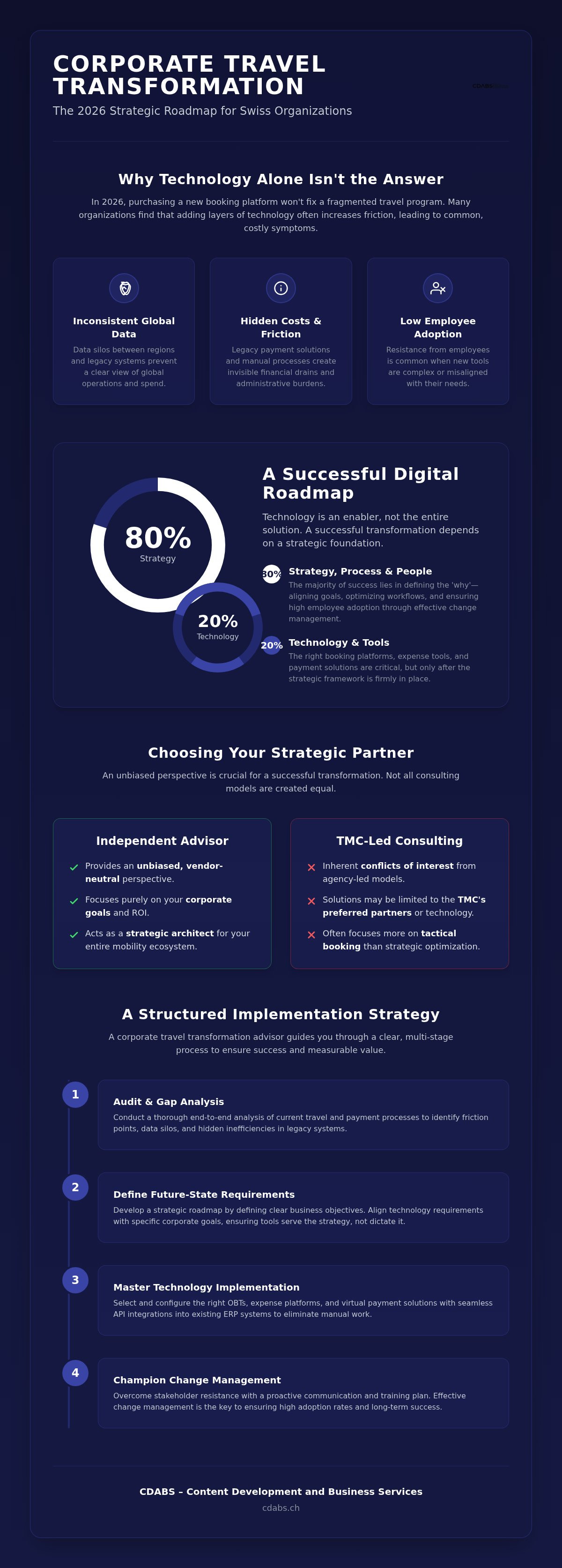
Technology is often mistaken for the solution itself. In reality, it represents only about 20% of a successful evolution. The remaining 80% is strategy, process, and people. A corporate travel transformation advisor helps define the "why" before the "what," ensuring that digital tools serve the business's specific objectives rather than dictating them. This begins with a rigorous audit of legacy systems to uncover hidden inefficiencies and data silos that prevent a clear view of global spend. Truly understanding digital transformation for business travel in 2026 means recognizing that data must be actionable, not just accessible. A roadmap that lacks strategic alignment will inevitably lead to low adoption and wasted investment.
Mastering Technology Implementation
Selecting the right Online Booking Tools (OBTs) and expense management platforms is a critical step in this journey. It's not enough for a tool to have a modern interface; it must offer seamless API integrations between travel data and your existing ERP systems. Without this connectivity, your team will continue to waste hours on manual data entry and reconciliation. Providing strategic business travel technology implementation guidance ensures that these tools are configured to reflect your company's travel policy and security requirements from day one. If you're unsure where your current stack falls short, reviewing your existing infrastructure with an expert can clarify the next steps toward a more integrated environment.
Optimizing Payment and Financial Solutions
Financial friction remains one of the largest "invisible" costs in corporate travel. Modernizing corporate card programs and adopting virtual payment solutions can significantly reduce the administrative burden on both travelers and finance teams. In the Swiss market, where precision is paramount, automated financial planning tools help eliminate the reconciliation lag that often follows large-scale trips or conferences. These manual processes often hide the true cost of travel, as staff time spent chasing receipts is rarely factored into the budget.
Independent Advisor vs. TMC-Led Consulting
Choosing between an agency-led consultant and an independent expert is a choice between a vendor and a strategic partner. Agency-led models often carry an inherent conflict of interest because their primary revenue stems from transaction volumes or specific technology stacks they represent. In contrast, a corporate travel transformation advisor operates with complete independence, prioritizing your organizational health over booking quotas. This project-based fee structure ensures that the advice you receive is focused entirely on efficiency and long-term value. It removes the pressure to recommend solutions that benefit the agency's bottom line rather than your own.
The Value of a Vendor-Neutral Perspective
Independence is your strongest asset when auditing current agency performance or reviewing complex contract terms. Without ties to a specific provider, an advisor can objectively evaluate whether your current TMC is delivering actual value or if a "best-of-breed" technology solution would better serve your needs. This objectivity is essential for calculating the ROI of business travel consulting. By using objective metrics rather than supplier-driven data, you gain a clear picture of how process optimization impacts your bottom line in CHF. You're free to select the tools that fit your workflow, rather than being forced into a single-stack solution.
Bespoke Solutions vs. Off-the-Shelf Programs
Standard global solutions frequently fail when applied to the specific cultural and regulatory requirements of the Swiss market. For an SME or a specialized NGO, an off-the-shelf program might be too rigid or lack the necessary local nuances. An advisor tailors every policy to your unique organizational culture, ensuring it's both practical and compliant. They don't just recommend a service; they negotiate bespoke supplier contracts on your behalf. This ensures you aren't paying for standard features that don't add value to your specific travel patterns.
Ultimately, the goal isn't to replace the agency, but to ensure the agency works for you. An independent corporate travel transformation advisor helps you run a transparent RFP process to select the best-fit partners. They provide the steady hand needed to hold these vendors accountable throughout the implementation phase and beyond. This methodical approach ensures that every partnership you enter is built on a foundation of transparency and mutual benefit.
The Human Factor: Change Management and Communication
Technology alone cannot drive organizational success. Research consistently shows that approximately 70% of digital transformations fail, largely due to poor stakeholder engagement and cultural resistance. A corporate travel transformation advisor understands that the human element is the most volatile variable in any rollout. Success requires more than just a technical switch; it demands a comprehensive strategy to manage the transition. By utilizing a structured approach to change management for corporate travel, organizations can move from skepticism to enthusiastic adoption.
Effective communication acts as the bridge between a complex digital roadmap and the daily reality of the employee. Instead of generic corporate announcements, an advisor crafts bespoke communication packages that translate technical changes into tangible traveler benefits. Whether it's reducing the time spent on expense reports or providing better mobile support during disruptions, the message must resonate with the individual's experience. This personal touch prevents the "change fatigue" that often plagues large-scale transitions.
Engaging Stakeholders from C-Suite to Frequent Flyer
Securing executive buy-in is the first step in ensuring long-term process modernization. Leadership needs to see how the transformation supports the broader corporate vision and protects the bottom line in CHF. However, the success of the program ultimately rests with the frequent flyers. Addressing traveler friction early on prevents the workaround behaviors that lead to fragmented data silos. Implementing structured feedback loops allows the advisor to capture real-world pain points and adjust the program before small frustrations become systemic issues.
Education and Continuous Learning
Knowledge transfer is a core component of a steady transition. Business travel masterclasses for internal teams provide the deep-dive training necessary to manage new systems with confidence. A corporate travel transformation advisor often takes on the role of a neutral moderator during stakeholder sessions, facilitating difficult conversations to reach a consensus on policy changes. This collaborative approach ensures that all departments feel heard and invested in the outcome.
Clear, accessible digital change documentation then serves as a permanent resource, empowering employees to navigate the new landscape independently. This methodical education reduces the reliance on external support and builds internal expertise. If your organization is struggling with low tool adoption, explore our change management communications packages to realign your team with your digital objectives.
Implementing Your 2026 Transformation Strategy
A successful evolution requires more than a software license; it demands a disciplined, phase-based methodology. A corporate travel transformation advisor guides your organization through a structured lifecycle that moves from initial discovery to long-term stability. This progression ensures that no technical requirement or stakeholder need is overlooked during the transition. By following a methodical path, you can replace legacy friction with modern excellence that supports your business objectives.
Phase 1: Discovery and Audit. We start by conducting a rigorous travel management system audit to identify financial leakage and process inefficiencies.
Phase 2: Future-State Design. We define the vision for 2026, documenting the exact technology and data requirements needed to meet your corporate goals.
Phase 3: Independent Selection. We run a vendor-neutral RFP process to select partners based on performance rather than platform bias.
Phase 4: Execution and Go-Live. This final phase covers rigorous testing and the rollout of a critical communication plan to ensure a smooth transition for all travelers.
Auditing for Success
Identifying where your program loses value is the foundation of any roadmap. By mapping every touchpoint in the traveler journey, we can pinpoint exactly where friction occurs and where data silos exist. Setting measurable KPIs for the first 12 months post-transformation allows you to track progress in real-time. Whether it's reducing manual reconciliation time or achieving specific savings in CHF, these metrics provide the quantifiable proof of success that leadership expects. It's about creating a baseline that makes every subsequent improvement visible and reportable.
Partnering with a Seasoned Advisor
Complexity often leads to hesitation, but having a corporate travel transformation advisor as a steady hand can help you navigate even the most intricate global rollouts. One of the primary advantages of this partnership is the ability to integrate event management logistics into your broader travel transformation. Too often, meeting spend remains unmanaged; however, an advisor ensures these high-cost areas are brought under the same strategic umbrella. This holistic oversight protects your budget while improving the experience for every attendee.
The journey toward a digital-first travel program doesn't have to be overwhelming. To begin your transition, reach out for a project-based consultation and discover how a customized roadmap can drive your organizational growth throughout 2026 and beyond.
Building Your Future-Ready Travel Ecosystem
Successful travel management in 2026 requires a shift from managing transactions to architecting a seamless mobility ecosystem. This transition relies on a strategic balance where technology serves organizational goals, rather than dictating them. By prioritizing independent oversight and structured change management, businesses can eliminate the hidden costs and employee friction that often stall digital progress. CDABS offers a vendor-neutral perspective. This ensures your interests always come first.
A corporate travel transformation advisor provides the steady hand needed to navigate these complex shifts. With over 30 years of strategic consulting experience, we bring a proven track record of helping both SMEs and global corporates achieve quantifiable results. It's time to move beyond legacy limitations and embrace a more efficient, digital-first future. Partner with CDABS for an independent, end-to-end travel transformation analysis to begin optimizing your program today. Your organization deserves a travel strategy that drives growth and supports your people with every journey.
Frequently Asked Questions
What exactly does a corporate travel transformation advisor do?
An advisor designs the strategic architecture for a modern mobility ecosystem. This involves auditing legacy payment systems, selecting vendor-neutral technology, and bridging gaps between HR, Finance, and Procurement. A corporate travel transformation advisor ensures that digital tools align with business goals rather than complicating them. They focus on reducing employee friction and optimizing global data fluidity to create a cohesive, digital-first roadmap for the entire organization.
How is an independent advisor different from my travel agency's consultant?
Independence is the primary differentiator. Agency consultants are often tied to specific booking platforms or transaction-based revenue models, creating a potential conflict of interest. An independent advisor works on a project basis and remains vendor-neutral, prioritizing your organization's specific needs. They help you audit your current agency's performance objectively and can even help you run a transparent RFP process to find a better partner if your current one falls short.
What is the typical ROI for a travel transformation project in 2026?
ROI is measured through both direct savings in CHF and indirect productivity gains. By automating manual reconciliation and optimizing payment workflows, companies often see a reduction in administrative overhead. While specific numbers vary by organizational size, the focus is on capturing "invisible" costs like staff time spent on expense reports. Improved compliance and better supplier negotiations further contribute to a program that pays for itself through long-term operational excellence.
How long does a full digital travel transformation usually take?
A comprehensive transformation typically spans six to twelve months, depending on the complexity of your current infrastructure. The process begins with a three-month audit and strategy phase, followed by technology selection and implementation. Larger global corporates with regional data silos may require more time for harmonization. However, smaller Swiss SMEs can often achieve a "Go-Live" state faster by focusing on a streamlined, scalable roadmap tailored to their specific growth targets.
Do SMEs really need a transformation advisor, or is this only for global corporates?
SMEs often benefit the most from specialized guidance. While global corporates have internal travel departments, SMEs frequently lack the dedicated expertise to navigate complex technology rollouts. An advisor helps smaller organizations build a scalable travel infrastructure from the ground up, preventing costly mistakes and ensuring that their systems can handle rapid national or international expansion. It's about setting a professional foundation that supports growth without inflating internal headcount.
What role does change management play in travel technology adoption?
Change management is the critical factor that determines whether new tools are actually used. Without a clear communication strategy, employees often revert to manual workarounds or "leakage" outside the program. An advisor crafts bespoke communication packages to translate technical changes into clear benefits for the traveler. This approach reduces resistance and ensures that your investment in new technology results in high adoption rates across the enterprise rather than becoming a wasted expense.
How can an advisor help with corporate event and conference logistics?
Advisors integrate meeting and event spend into your broader travel strategy to provide a holistic view of corporate spend. This involves auditing event logistics, negotiating supplier contracts, and ensuring that conference travel follows the same digital-first processes as standard business trips. By centralizing these often-unmanaged expenses, an advisor helps capture more data and identifies significant opportunities for optimization in CHF, ensuring that large-scale events are both cost-effective and well-coordinated.
What are the biggest mistakes companies make during travel transformation?
The most common error is treating transformation as a software purchase rather than a strategic shift. Many organizations implement new tools without auditing their existing processes, which simply automates current inefficiencies. Other mistakes include failing to secure C-Suite buy-in or ignoring the human element of change. A corporate travel transformation advisor helps you avoid these pitfalls by establishing a clear roadmap that prioritizes process optimization and stakeholder engagement before any software is selected.


Comments