
Strategic Business Travel Consulting: 2026 Guide
Updated: Sep 2
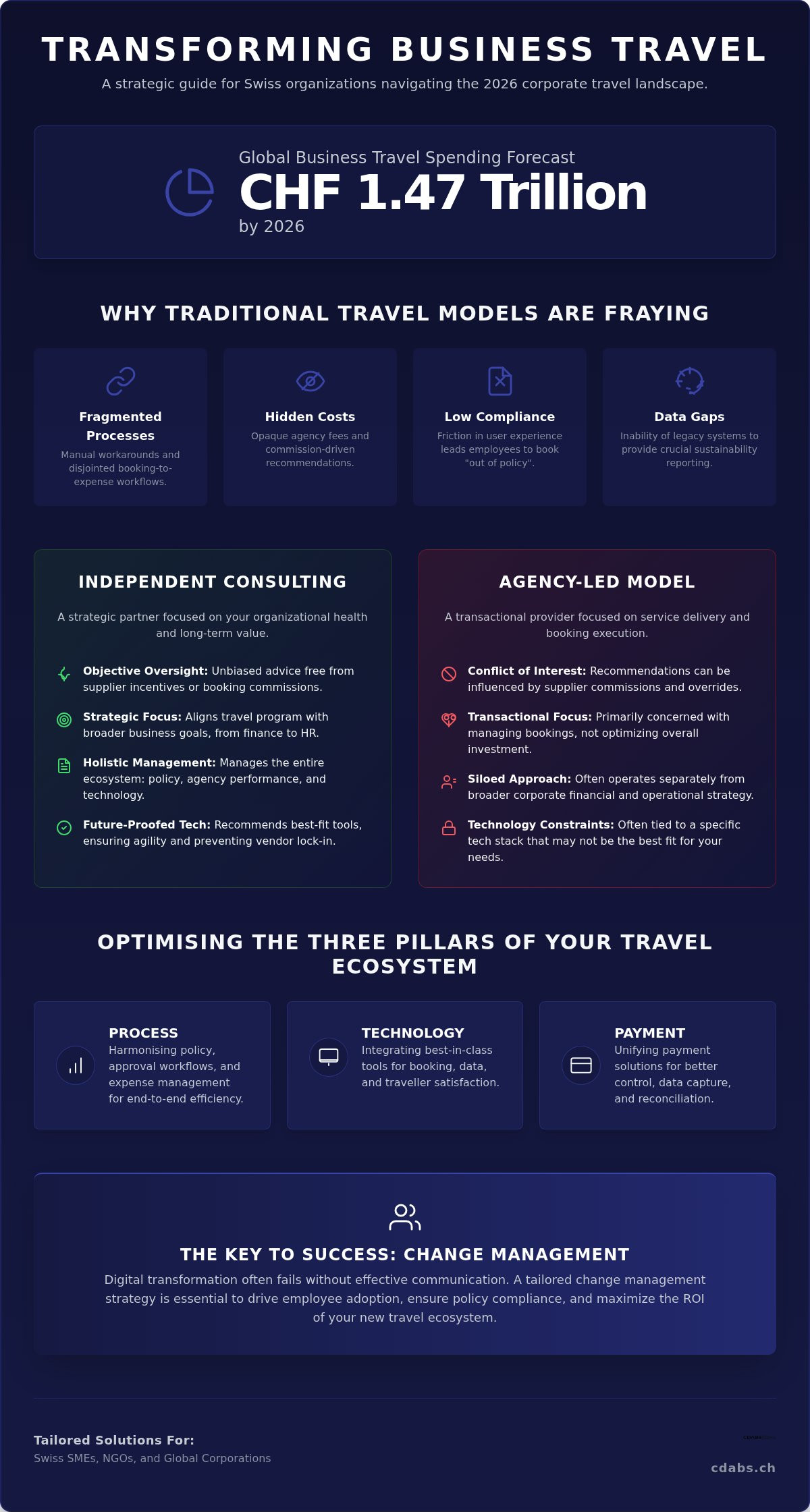
With global business travel spending forecast to hit a record CHF 1.47 trillion in 2026, why do so many Swiss organisations still struggle with fragmented processes and hidden costs? You might find that despite rising budgets, your travel programme feels like a collection of opaque agency fees and manual workarounds. This is where independent business travel management consulting becomes essential. It provides a steady, objective hand to help you move beyond the limitations of a single travel agency or rigid software provider.
We understand that the friction of low policy compliance and the headache of integrating new tech with your ERP system can stall your progress. It's a common challenge, but it isn't a permanent one. This guide promises to show you how to transform these pain points into a streamlined, employee-centric ecosystem. We will walk through the steps to achieve a transparent, optimised process that ensures your digital transformation is future-proof and your travellers remain satisfied. By aligning your strategy with modern operational excellence, you can finally turn travel from a cost centre into a strategic advantage.
Table of Contents
The Evolution of Business Travel Management Consulting in 2026
Business travel has transformed from a simple procurement exercise into a high-stakes strategic function. By 2026, the complexity of global markets and shifting regulations means that business travel management consulting is no longer a luxury reserved for the largest firms. It's a fundamental requirement for any Swiss organisation looking to maintain operational health and financial clarity. We define business travel management consulting as the objective alignment of corporate policy, technology, and traveller behaviour.
The focus has shifted significantly. While cost-cutting used to be the primary goal, we now prioritise traveller-centric optimisation. This approach creates a programme that employees actually want to use, which naturally drives compliance and reduces the friction of manual expense reporting. In an era where global business travel spending is forecast to reach record levels, having a strategy that balances fiscal discipline with employee satisfaction is the only way to remain competitive.
Why Traditional Travel Models are Fraying
Traditional models are struggling to keep pace with a fragmented market. Between direct-to-supplier bookings and the expansion of New Distribution Capability (NDC), travellers have more choices than ever before. This fragmentation makes it nearly impossible for legacy systems to provide a clear view of spending. Many legacy Travel Management Companies (TMCs) struggle to offer objective advice because their revenue models often depend on booking commissions rather than strategic outcomes. Additionally, the Corporate Travel Management landscape is now burdened by intense data requirements. Organisations must now account for precise sustainability reporting under new frameworks, such as the proposed EU ETS extensions for aviation, which require a level of detail that old booking tools simply can't provide.
The Role of the Independent Strategic Advisor
An independent advisor acts as a steady, experienced hand amidst this complexity. Unlike an agency, a consultant doesn't profit from your booking volume or specific software choices. This independence builds trust, as every recommendation is focused purely on your organisational goals. We act as a bridge between procurement's need for cost control and the traveller's need for a seamless experience. With over 30 years of industry experience across SME, NGO, and global corporate sectors, we understand how to navigate these diverse challenges. We help you move from a reactive state to a controlled, proactive strategy that integrates payment solutions and digital tools into a single, cohesive ecosystem. This ensures your travel programme isn't just a cost centre, but a well-oiled machine that supports your broader business objectives. If you need to bring in independent consultants to achieve this level of strategic alignment, you can find out more about specialized professional networks.
Independent Strategy vs. Agency-Led Models: Making the Right Choice
Many organisations operate under the assumption that their Travel Management Company (TMC) provides all the strategic guidance they need. While an agency is an essential execution partner, its primary function is transactional. In contrast, business travel management consulting serves as an architectural layer that sits above the agency. The most common objection we hear is, "We already have an agency, so why do we need a consultant?" The answer lies in the distinction between service delivery and strategic oversight. An agency manages your bookings; a consultant manages your agency, your policy, and your overall investment.
A strategic advisor provides the objective distance necessary to evaluate whether your current setup actually serves your bottom line. Agencies are often locked into specific tech stacks or commercial agreements that may not be the best fit for your evolving needs. By engaging in independent consulting services, you gain an advocate whose only priority is your organisational health. This partnership allows you to hold your service providers accountable while ensuring your travel ecosystem remains agile and cost-effective.
Evaluating the Conflict of Interest
The traditional travel model is frequently built on commission-based structures and preferred supplier overrides. These hidden incentives can subtly influence an agency's recommendations, leading to choices that benefit the provider's margins rather than your budget. For example, an agency might nudge travellers toward specific hotel chains or airlines where they receive higher backend overrides. An independent consultant operates on a transparent fee-for-service model. This eliminates bias and ensures that every technology selection or vendor contract is chosen purely for its merit and alignment with your goals. Total transparency is the only way to guarantee that your Swiss Francs are being spent effectively.
Maximising ROI Through Objective Oversight
Identifying "leakage" is a critical part of the consulting process. This refers to bookings made outside of the official programme, which agencies often overlook because they lack visibility into external data. A consultant performs a deep-dive audit to find these gaps and bring that spend back under control. We use benchmarking data that spans multiple providers and industries to ensure you aren't paying more than the market rate for booking fees or management services. In 2026, with TMC management fees sometimes exceeding CHF 100,000 for larger firms, even a small percentage of optimisation leads to significant savings. This project-based oversight ensures that your digital transformation goals are met without the agency "grading its own homework."
Optimising the Three Pillars: Process, Technology, and Payment
Effective travel programmes aren't built on software alone. They're built on the seamless integration of three distinct pillars: process, technology, and payment. Our approach to business travel management consulting begins with an exhaustive end-to-end analysis of your current workflow. We look for the hidden friction points where manual tasks slow down your team and inflate your costs. By mapping out every touchpoint, from the initial trip request to the final financial reconciliation, we identify the specific operational gaps that need closing. Modern digital transformation in this space isn't just about flashy interfaces; it's about efficiency. Industry benchmarks show that automating these travel and expense workflows can reduce the total administrative burden on your staff by up to 40%.
Digital Transformation and Technology Implementation
Selecting an Online Booking Tool (OBT) requires more than a checklist of features. It must align with your corporate culture and the specific needs of your travellers. We guide you through the process of global travel management solutions implementation, ensuring that your chosen platform doesn't operate in a vacuum. A successful rollout requires a seamless data flow between travel systems, HR records, and finance ERPs. During our business travel management consulting engagements, we also audit your existing systems to find underutilised features. Many Swiss organisations pay for advanced capabilities they never actually activate, missing out on valuable automation and reporting data that could drive better decision-making.
Streamlining Payment and Expense Solutions
Payment is often the most neglected pillar of travel strategy. We advocate for a shift toward virtual cards and automated reconciliation to eliminate the need for traditional expense reports. This transition significantly reduces friction for frequent flyers, who no longer need to carry the burden of corporate spend on personal cards or wait weeks for reimbursement. For the finance department, these modern solutions offer real-time visibility into spending patterns. Improved financial planning becomes possible when you can see commitments as they happen, rather than waiting for invoices to arrive 30 days later. This level of control is essential for managing the rising costs of hotel and airfare predicted for the 2026 travel season, where hotel rates are expected to rise by 3.9% globally. By modernising your payment stack, you ensure that every Swiss Franc spent is accounted for and optimised.
Change Management: Why Digital Transformation Fails Without Communication
Even the most sophisticated booking tool is a failed investment if your employees refuse to use it. Many organisations spend significant portions of their budget on new software only to find that travellers continue to book off-programme because the new system feels cumbersome or confusing. Our approach to business travel management consulting places human behaviour at the centre of the strategy. We believe that successful digital transformation is 20% technology and 80% change management. If you don't address the underlying culture of your organisation, you'll never achieve the compliance rates needed to justify your spend.
The Human Element of Travel Transformation
Traveller friction is more than just a minor annoyance. It's a significant barrier to policy compliance and data accuracy. When employees feel that a new tool makes their lives harder, they naturally find workarounds. To prevent this, we focus on securing executive buy-in early in the process. Leaders must lead by example to show that the new programme is a priority for the entire business. We also utilise training sessions and professional masterclasses to bridge the knowledge gap. Drawing on experience from over 500 professional events, we help your team understand not just how to use the tool, but why it benefits them personally. This steady, experienced hand ensures that complex transitions are managed with a calm and controlled perspective, preventing the loss of momentum during the rollout phase. This hands-on facilitation turns a potentially cold corporate rollout into a collaborative effort.
Bespoke Communications for Seamless Change
Effective communication isn't a one-size-fits-all email from the CEO. It requires a nuanced narrative that resonates with different departments. Finance needs to hear about the transparency and cost savings, while Sales teams need to know that the new system will save them time on the road. We provide Change Management Communications Packages that are specifically tailored to these varying perspectives. A well-structured narrative acts as the glue that holds the various pillars of your travel strategy together. By creating clear, departmentalised messaging, we reduce the anxiety that often accompanies a global travel solutions implementation. This proactive communication ensures that every stakeholder feels heard and supported. When employees understand the "why" behind the change, they're far more likely to become advocates for the new system rather than obstacles to its success.
Tailored Solutions for SMEs, NGOs, and Global Corporates
Every organisation has a different pulse. A global multinational's needs for business travel management consulting look nothing like those of a local Swiss NGO or a growing SME. We provide a versatile perspective that adapts to these varying scales. Our service is truly end-to-end, moving from the initial audit and analysis through to the final implementation and long-term delivery of a streamlined programme. Whether you're managing a handful of travellers or a workforce of thousands, the goal remains the same: creating a programme that is both fiscally responsible and supportive of your people.
Scaling Strategy for SMEs
For many Swiss SMEs, travel is often "unmanaged," meaning employees book their own trips without a central framework. This lack of structure leads to wasted time and invisible costs. We help you move to a managed model without the need to hire a full-time travel manager. By identifying cost-effective tools that grow with your business, we ensure your infrastructure is future-proof. Our professional moderation services are particularly valuable during SME strategic sessions. We facilitate these discussions to help leadership teams align on travel priorities, ensuring that the transition to a managed programme is smooth and collaborative. This allows you to scale your operations without adding unnecessary headcount.
Specialised Oversight for NGOs
Mission-driven organisations face unique pressures that traditional corporate models often ignore. NGOs must navigate complex global duty of care requirements, especially when sending staff into high-risk or remote regions. Budget transparency is also non-negotiable, as donor-funded travel requires a granular level of reporting to maintain trust and compliance. Our specialised business travel management consulting for NGOs focuses on developing bespoke travel policies that respect these mission-driven values while maintaining strict financial control. By providing an independent layer of oversight, we ensure that every CHF spent on travel directly supports the organisation's core mission. This pragmatic approach helps maintain the delicate balance between operational efficiency and the safety of your field teams.
Our expertise across these diverse sectors allows us to function as both a strategic architect and a hands-on facilitator for the entire Swiss market. We don't just hand over a report; we stay involved to ensure the change takes root. This commitment to the success of our partners is what defines our role as a trusted advisor in the Swiss business landscape. We bridge the gap between high-level strategy and the intricate details of daily execution, providing a steady hand through every stage of your travel programme's evolution.
For global organizations whose operational needs extend into specialized maritime logistics, having a similarly reliable partner is crucial; for instance, those navigating the Panama Canal can read more about dedicated ship agency support.
Building a Resilient Travel Strategy for the Future
Modernising a corporate travel programme requires more than just new software. It demands a holistic alignment of technology, payment systems, and human behaviour. We've discussed how independent oversight ensures your strategy remains unbiased and how bespoke communication prevents digital transformation from stalling. By focusing on these strategic pillars, Swiss organisations can navigate the complexities of 2026 with confidence and clarity. Every step taken toward optimisation strengthens your bottom line and improves the daily experience of your travellers.
With 30 years of seasoned authority in business services, CDABS – Content Development and Business Services provides the objective perspective needed to audit existing agency relationships and implement high-impact solutions. Our expertise in comprehensive change management ensures that your team doesn't just receive new tools but adopts them. Whether you're an SME scaling up or an NGO requiring total budget transparency, our business travel management consulting offers a steady hand through every stage of the project lifecycle. The path to a streamlined, cost-effective ecosystem starts with a single conversation. Optimise your travel program with CDABS – Content Development and Business Services - Book a Strategic Consultation. We look forward to helping you transform your travel programme into a strategic asset.
Frequently Asked Questions
What is the difference between a Travel Management Company and a travel consultant?
A Travel Management Company (TMC) primarily executes bookings and manages the logistics of your trips. In contrast, business travel management consulting provides a layer of strategic oversight that governs your entire travel ecosystem. While the TMC is your execution partner, a consultant acts as an architect. We focus on auditing your current agency's performance, refining your corporate policy, and ensuring that your technology stack actually serves your long-term business objectives without being tied to agency-specific incentives.
How does business travel management consulting help reduce corporate costs?
Consulting reduces costs by identifying hidden agency fees and spend "leakage" that often goes unnoticed in standard reporting. We perform a deep-dive audit of your processes to uncover underutilised software features and negotiate better supplier rates based on industry benchmarks. For larger Swiss organisations, even a small percentage of optimisation can save over CHF 100,000 in annual management fees. Our independent perspective ensures every Swiss Franc spent on travel is aligned with your strategic procurement goals.
Can an independent consultant help us select a new Online Booking Tool?
Yes, an independent consultant provides an objective evaluation of the market to find the Online Booking Tool (OBT) that fits your specific culture. Unlike agencies that may be incentivised to push proprietary software, we look for solutions that integrate seamlessly with your existing HR and finance ERP systems. We manage the entire selection process, from defining requirements to final implementation, ensuring your digital transformation is based on merit and operational efficiency rather than vendor commissions.
What is included in a change management communications package for travel?
Our Change Management Communications Packages include a structured narrative that explains the "why" behind travel policy shifts to your employees. We provide tailored messaging for different departments, such as Finance and Sales, to address their specific concerns and benefits. The package also includes rollout schedules and training materials designed to reduce anxiety and drive high adoption rates. This proactive approach ensures that your team feels supported throughout the transition to a more streamlined travel programme.
How long does a typical travel process optimisation project take?
A typical travel process optimisation project usually follows a structured lifecycle lasting between three and six months. The initial analysis and audit phase generally takes four to six weeks, followed by the development of a tailored strategy. Implementation and change management activities then follow to ensure the new processes take root. The exact timeline depends on the complexity of your current setup and whether you are integrating global travel management solutions across multiple international locations.
Do we need to change our current travel agency to work with a consultant?
You don't need to change your current agency to benefit from consulting; we often work to improve existing relationships. Our role is to act as a bridge, helping you hold your current provider accountable for their performance and service level agreements. We identify areas where the agency can deliver better value and help you implement the necessary changes. If a change is eventually required, we manage the tender process to ensure a smooth transition.
How does digital transformation specifically reduce "traveller friction"?
Digital transformation reduces traveller friction by automating manual tasks that traditionally cause stress, such as expense reporting and complex booking approvals. By implementing intuitive tools and virtual payment solutions, we eliminate the need for employees to carry the burden of corporate costs on personal cards. This results in a more seamless experience that allows your frequent flyers to focus on their core work rather than administrative hurdles. It's about creating an employee-centric ecosystem that fosters higher policy compliance.
Does CDABS provide support for corporate event and conference planning as well?
Yes, we provide comprehensive Meeting and Conference Organization services alongside our strategic consulting work. We apply the same methodical and thorough approach to your corporate events as we do to your travel strategy. This includes managing logistics, technology integration, and professional moderation to ensure your events are both impactful and cost-effective. By centralising your travel and event strategy, you achieve better visibility and control over your total meeting spend across the Swiss national market.


Comments