
SME Travel Management: Strategic Guide for 2026
Updated: Aug 30
Your travel budget isn't just a line item to be minimized; it's a strategic lever for growth that most small and medium enterprises leave completely unpulled. Many leaders feel the daily weight of invisible spending and the friction of manual expense reconciliation, yet they often assume professional oversight is reserved for global conglomerates. This is where SME travel management consulting changes the equation. You've likely felt the frustration of rigid policies that don't quite fit your culture or the anxiety of realizing your duty of care compliance is more of a hope than a documented process.
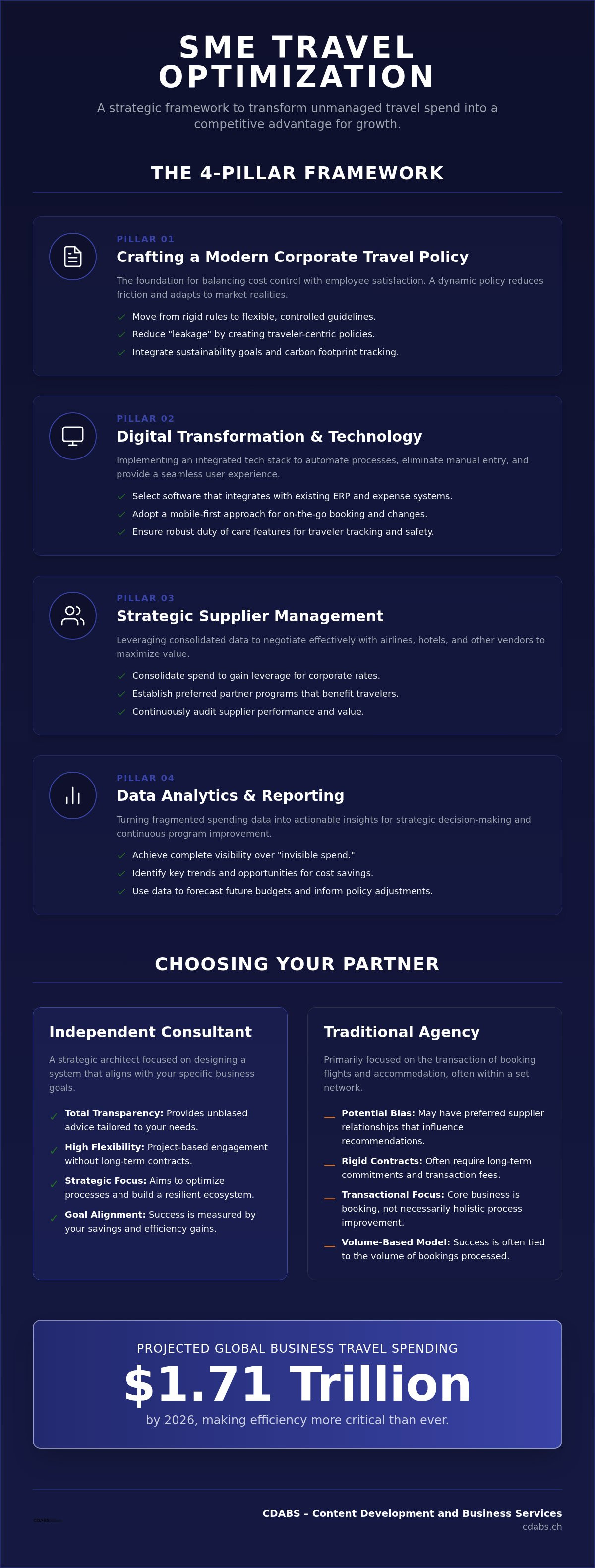
We believe your goal isn't just to book flights, but to build a resilient, digital-first travel ecosystem that respects both your bottom line and your travelers' comfort. With global business travel spending projected to reach up to $1.71 trillion in 2026, the stakes for efficiency have never been higher. This guide provides a professional framework to transform chaotic, unmanaged spend into a streamlined asset. We will explore how to implement global solutions that scale with your reach, achieve significant cost savings through process optimization, and finally gain the data clarity you need to lead with confidence.
Table of Contents
Beyond DIY: Why SMEs Need Strategic Travel Management Consulting
Many business leaders view travel as a necessary expense rather than a strategic asset. At its core, SME travel management consulting is the process of aligning every dollar spent on transit and accommodation with your broader organizational goals. While a travel agent focuses on the transaction of booking a seat, a consultant acts as a strategic architect. They design the systems that ensure your travel program supports your bottom line while maintaining the flexibility a growing business requires.
The "tipping point" usually arrives when manual booking becomes a liability for growth. This often happens when your team grows beyond a handful of frequent travelers and the CFO loses sight of where the money is actually going. This leads to "invisible spend," where fragmented bookings across various platforms make it impossible to track total costs or negotiate better rates with suppliers. Without a cohesive strategy, you aren't just spending money; you're losing the ability to manage it.
The Hidden Costs of Fragmented Travel Processes
Fragmented processes create a drain on productivity that rarely appears on a balance sheet. When employees spend hours scouring the web for the "cheapest" fare, they aren't just saving fifty dollars; they're losing hundreds in billable or strategic time. This "DIY" approach often masks the true cost of travel. Without centralized data, you lack the leverage to secure corporate rates or volume discounts. Corporate travel management requires visibility to be effective. Beyond the financial leak, there's the risk of non-compliance. If you don't know where your employees are during a global disruption, your duty of care gaps become a significant legal and moral liability.
When to Engage a Corporate Travel Transformation Advisor
Recognizing the signs of an outdated workflow is crucial for scaling. If your finance team spends days reconciling credit card statements against manual expense reports, you've outgrown your system. A consultant doesn't just offer advice; they implement global travel management solutions that pay for themselves through recovered time and direct savings. This is especially vital for Swiss-based companies with international reach. An advisor ensures that as you expand into new markets, your travel infrastructure is ready to support that growth without the administrative friction that stalls momentum. Engaging SME travel management consulting on a project basis provides the expertise you need without the long-term commitment of an agency contract.
The 4-Pillar Framework for SME Travel Optimization
Building a professional travel program requires more than just a login for a booking tool. It demands a holistic architecture that addresses the specific needs of your business. To achieve this, we utilize a four-pillar framework designed to bring order to fragmented systems and turn travel into a competitive advantage. This framework moves beyond simple cost-cutting to create a resilient, modern operation that scales with your ambitions.
Crafting a Modern Corporate Travel Policy
Policy development is the first pillar. It serves as the foundation for balancing financial savings with employee satisfaction. A rigid policy often leads to "leakage" as travelers book outside the system to find comfort or convenience. Instead, we advocate for a dynamic policy. A dynamic policy is a strategic tool that adapts to real-time market fluctuations rather than relying on static, annual price caps. By incorporating flexible yet controlled guidelines, you reduce friction for your team while maintaining oversight. Modern frameworks also prioritize sustainability, allowing you to track carbon footprints and favor eco-certified partners as standard practice, which is increasingly a requirement for reporting and brand reputation.
Digital Transformation: Implementing Travel Technology
The second pillar is your technology stack. Selecting the right travel management software selection is a decision that affects every department, from finance to HR. The goal is seamless integration with your existing ERP and expense management systems to eliminate manual data entry. A mobile-first approach is no longer optional; your team needs the ability to manage changes on the fly. According to Global Business Travel Association research, technology adoption is the primary driver for improved traveler compliance and data accuracy.
The third pillar focuses on payment and reconciliation. We aim to streamline the entire "booking-to-billing" cycle, moving away from manual invoice matching. By implementing automated payment solutions, you reduce the administrative burden on your finance team and gain immediate visibility into cash flow. Finally, the fourth pillar is duty of care. In an era of heightened global security risks, ensuring traveler safety and organizational compliance is a moral and legal necessity. This involves real-time tracking and clear communication protocols for travelers in transit. Beyond travel logistics, ensuring your company meets its wider regulatory obligations is vital, and AA Compliance Compass Ltd provides the practical compliance and business support services that SMEs need to operate safely.
Implementing these pillars takes a steady hand and deep industry knowledge. If you're ready to modernize your approach, exploring SME travel management consulting can provide the strategic oversight needed to execute this transformation successfully. This methodical progression ensures that no detail is overlooked as we move from initial analysis to final delivery.
Choosing between a Travel Management Company (TMC) and independent consulting is a pivotal decision for any growing business. Most agencies operate on a transactional model where revenue is tied to booking volume and supplier commissions. While this works for simple logistics, it can subtly misalign the provider's incentives with your goal of reducing overall spend. Independent SME travel management consulting removes this conflict. By working on a project-based or fee-only structure, a consultant focuses entirely on strategic architecture and process optimization rather than the number of flights booked.
The Advantage of Independent Advisory
An independent advisor provides the objective perspective needed to audit your current travel management systems effectively. Dominic Short brings 30 years of experience to this role, offering the calm, controlled perspective of someone who has navigated diverse industry cycles. This depth of knowledge allows for a thorough analysis of your organizational health, identifying where processes are leaking value. For Swiss-based companies with international reach or NGOs with complex compliance needs, this unbiased oversight is essential. It allows you to implement global travel management solutions that are selected based on merit and fit rather than commission structures. Because the model is project-based, it offers a level of flexibility that traditional long-term agency contracts simply cannot match.
Service-Led vs. Tech-First Solutions
The rise of self-service booking tools has led some to believe that technology alone is the answer. However, a purely digital platform often lacks the nuance required for high-level executive travel or intricate international itineraries. A consultant helps you bridge the gap between automated efficiency and human expertise. They act as a strategic architect to ensure your technology stack handles the routine, while expert oversight remains available for complex logistics and change management. This balance is particularly critical for NGOs and globally operating corporates that must reconcile strict budget constraints with high-risk travel environments. By prioritizing service-led strategy alongside modern tech, you create a travel program that is both lean and resilient. Engaging in SME travel management consulting allows you to build a program that doesn't just manage travel, but actively contributes to your company's operational excellence and long-term stability.
How to Audit and Streamline Your Business Travel Processes
Transforming a chaotic travel program into a streamlined asset requires a methodical, step-by-step audit. We begin with data consolidation. This involves gathering every scrap of spend from corporate credit cards, supplier invoices, and individual expense reports to create a single source of truth. Without this visibility, you're flying blind. Next, we conduct stakeholder interviews. By speaking directly with frequent travelers and your finance team, we identify the specific friction points that lead to policy non-compliance and administrative burnout.
Once the data and feedback are in hand, we perform a gap analysis. This stage compares your current state against established strategic business travel consulting benchmarks to highlight areas for immediate improvement. Finally, we design a roadmap. This isn't a generic template; it's a phased implementation plan that introduces new technology and policies at a pace your organization can absorb. This methodical flow ensures that we manage intricate details while never losing sight of your broader strategic objectives.
Optimizing Corporate Travel Payments
Modernizing how you pay for travel is one of the fastest ways to drive efficiency. Implementing virtual cards and centralized billing reduces the administrative burden on employees and finance departments alike. It effectively eliminates the need for personal reimbursements and simplifies the reconciliation process. Industry data indicates that optimized payment solutions can reduce indirect travel costs by up to 15% by eliminating manual processing and improving spend visibility. This pragmatic shift in financial flow ensures that your travel program remains an engine for growth rather than a source of clerical frustration. For businesses looking to maintain this momentum and secure future funding, visit Davis & Co LLP to understand what lenders look for in audited financials.
As Swiss-based companies expand, they often face the complexity of multi-currency and multi-jurisdictional travel requirements. SME travel management consulting provides the framework to standardize processes across international offices while respecting local market nuances. This is particularly vital when preparing for large-scale corporate event logistics or international conferences where the stakes are higher and the logistics more complex. We help you build a scalable infrastructure that maintains a steady hand on costs while supporting your global reach. If you're ready to audit your current workflow and modernize your systems, reach out to begin your travel transformation today.
Change Management: The Secret to Travel Program Adoption
The success of a new travel program is rarely determined by the software itself. Instead, it hinges on the human element. Most organizational transitions fail because leadership assumes employees will simply adopt a new tool because it exists. In reality, a lack of clear, empathetic communication is the primary culprit behind low adoption rates. This is where professional SME travel management consulting provides its greatest value, shifting the focus from technical deployment to behavioral alignment. By prioritizing the "people" side of the equation, you ensure that your strategic architecture actually functions in the real world.
Effective change management for corporate travel significantly reduces traveler anxiety during periods of transition. When employees understand why a change is happening and how it benefits their daily workflow, resistance turns into advocacy. Measuring success must therefore go beyond simple cost savings. We look at traveler satisfaction scores and compliance rates as the true indicators of a healthy program. A program that saves money but frustrates your top talent is not a sustainable solution.
Bespoke Communications for Digital Change
Different levels of your organization require different narratives. While executives need to understand the impact on organizational health and ROI, your frequent flyers are more concerned with ease of use and personal safety. We develop bespoke change management communications packages that deliver the right message to the right audience. This internal marketing approach "sells" the benefits of the new program, framing it as a solution to previous friction points rather than a new set of restrictions. During this transition, a consultant acts as both a mentor and a facilitator, providing the steady, experienced hand needed to navigate the inevitable questions of a shifting workforce.
Continuous Education and Masterclasses
A travel program is not a static project; it's an evolving ecosystem. To maintain momentum, we offer business travel masterclasses for internal teams. These sessions provide ongoing education that ensures your travel policy remains relevant as your business grows or market conditions shift. This dedication to continuous learning prevents the program from stagnating and keeps your team aligned with global best practices. If you're ready to transform your unmanaged spend into a strategic asset, contact CDABS for a tailored analysis of your travel ecosystem. We combine decades of professional experience with a personal investment in your success.
Elevate Your Corporate Travel Strategy for 2026
Transitioning from fragmented, unmanaged travel to a professional framework is a vital step toward long-term organizational health. By implementing the four pillars of optimization and prioritizing empathetic change management, you move beyond simple booking to true strategic oversight. Independent SME travel management consulting provides the unbiased perspective needed to audit existing systems and select technology based on merit rather than supplier commissions. We act as a steady, experienced hand to guide your digital transformation and global expansion, drawing on 30 years of high-level strategic experience.
We don't just implement tools; we provide bespoke change management communications to ensure your team feels supported and confident throughout the transition. This approach creates a resilient ecosystem where significant cost savings and traveler comfort coexist seamlessly. It's time to stop viewing travel as a chaotic expense and start treating it as a strategic lever for growth. Optimize your corporate travel strategy with CDABS and take the first step toward a more efficient, digital-first future. Your organization deserves a travel program that works as hard as your team does.
Frequently Asked Questions
What is the difference between an SME travel consultant and a travel management company (TMC)?
An SME travel consultant provides independent, strategic architecture on a project basis, while a TMC is a transactional agency focused on booking execution. Consultants don't rely on supplier commissions; instead, they focus on your organizational health. This distinction is crucial for businesses seeking unbiased advice on technology and policy. By engaging in SME travel management consulting, you gain a partner who prioritizes your specific business objectives over booking volume or agency incentives.
How much can an SME expect to save by hiring a travel management consultant?
Savings vary based on your current level of fragmentation, but process optimization typically reduces indirect travel costs by up to 15%. These gains come from automating reconciliation and eliminating the time employees spend searching for fares. Direct savings are also achieved through better supplier negotiations and improved policy compliance. A consultant identifies where your budget is leaking and implements frameworks that turn travel spend into a measurable strategic asset.
Does our business need a certain amount of travel spend before consulting makes sense?
There isn't a fixed monetary threshold, but the need for consulting arises when manual processes begin to stall your growth. If your finance team is overwhelmed by expense reports or you've lost visibility into total spend, you've reached the tipping point. Consulting often pays for itself through recovered administrative time and improved data clarity. It's about the complexity of your travel lifecycle rather than just the total dollar amount spent.
Can a consultant help us select and implement a new travel booking tool?
Yes, unbiased technology implementation is a core service. We audit your existing ERP and expense systems to ensure any new booking tool integrates seamlessly into your workflow. Unlike agencies that may have preferred software partners, we focus entirely on what fits your culture and operational needs. This ensures your digital transformation is driven by functionality and traveler adoption rather than external sales incentives or rigid, one-size-fits-all platforms.
How does travel management consulting address duty of care for small businesses?
We build robust frameworks that ensure your organization meets its legal and moral safety obligations. This includes implementing real-time traveler tracking and automated safety alerts to manage heightened global security risks. For small businesses, this level of oversight is often missing in DIY models. By professionalizing your duty of care protocols, we ensure your team feels supported and secure, regardless of where their business objectives take them.
What is involved in a corporate travel process audit?
A corporate travel audit is a methodical progression that begins with data consolidation from credit cards and invoices. We then conduct stakeholder interviews to identify friction points for both travelers and finance teams. This is followed by a gap analysis against industry benchmarks and the design of a phased implementation roadmap. This structured approach ensures we manage every intricate detail of your travel ecosystem while never losing sight of your broader strategic goals.
Do you provide consulting for NGO travel programs specifically?
We provide specialized SME travel management consulting tailored to the unique needs of NGOs and non-profit organizations. These programs often require a delicate balance between strict donor-mandated budget constraints and the necessity of high-risk travel logistics. We help NGOs implement global solutions that prioritize duty of care and process efficiency, ensuring that every cent of travel spend is accounted for and aligned with the organization's mission and compliance requirements.
How long does a typical travel transformation project take to implement?
A typical travel transformation project generally takes between three and six months from initial analysis to final delivery. This timeline allows for a thorough audit, technology selection, and the rollout of bespoke change management communications. The duration varies depending on the complexity of your international reach and the scale of the digital change required. We move at a steady, methodical pace to ensure the new program is fully adopted by your workforce.


Comments