
NGO Travel Program Optimization: A Strategic Guide for 2026
Updated: Aug 30
What if the very tools your team uses to reach the world's most vulnerable populations are actually the ones holding your mission back? For many organizations, the friction of manual booking and fragmented spend data isn't just an administrative headache; it's a drain on the resources meant for the field. Achieving effective NGO travel program optimization requires a shift from reactive logistics to a proactive, strategic architecture. It's about ensuring that every dollar spent on a flight or a remote stay is a dollar working toward your core purpose, backed by the transparency your donors demand.
You likely feel the pressure to modernize while maintaining a lean operation, yet the complexity of remote field work often makes digital transformation feel out of reach. This guide provides a roadmap to bridge that gap, promising a path toward a streamlined, digital-first process that prioritizes traveler safety and fiscal accountability. We'll explore how to implement sophisticated management solutions that provide total visibility into your travel spend, simplify life for your workers in the field, and ensure your organization remains a steady, reliable steward of its mission through 2026 and beyond.
Table of Contents
The Evolution of NGO Travel Program Optimization in 2026
NGO travel program optimization is no longer just about finding the cheapest flight. In 2026, it represents a precise alignment where logistics and technology serve the broader mission. With global travel spending projected to face continued inflationary pressure, every Non-governmental organization (NGO) must justify its mobility. Geopolitical volatility has made traditional, reactive booking models obsolete. You need a strategy that anticipates disruption rather than simply reacting to it. This evolution requires a shift toward a resilient infrastructure that protects both the traveler and the budget.
Standard corporate travel models frequently fall short because they prioritize business hubs over humanitarian frontiers. They don't account for the "last mile" where paved roads end and mission-critical work begins. Moving from a reactive stance to proactive, strategic management ensures that your team isn't just traveling, but is positioned to deliver impact efficiently. It's the difference between simply booking a ticket and managing a global movement of people and resources with quiet confidence.
Mission-Critical vs. Discretionary Travel
Distinguishing between travel that drives field outcomes and administrative overhead is essential when donor funding is under intense scrutiny. It's about prioritizing resources where they matter most. You should ask if a face-to-face intervention is required or if digital alternatives suffice. While high-touch field work remains irreplaceable, optimizing the program means identifying which trips are truly mission-critical. This clarity allows you to allocate limited funds to the front lines where they can do the most good, ensuring fiscal accountability doesn't compromise operational reach.
The Role of Independent Consulting
Selecting a new travel platform before analyzing your internal processes is a common pitfall. An independent advisor offers a perspective that a biased agency representative cannot provide. By conducting an end-to-end process analysis first, you ensure the technology fits the organization, not the other way around. This "seasoned hand" approach leverages decades of experience to navigate complex transitions smoothly. For a deeper look at how this works, explore our Strategic Business Travel Consulting: 2026 Guide. This level of oversight ensures that your NGO travel program optimization is built on a foundation of operational excellence rather than just a software subscription.
The Core Pillars of a Resilient NGO Travel Policy
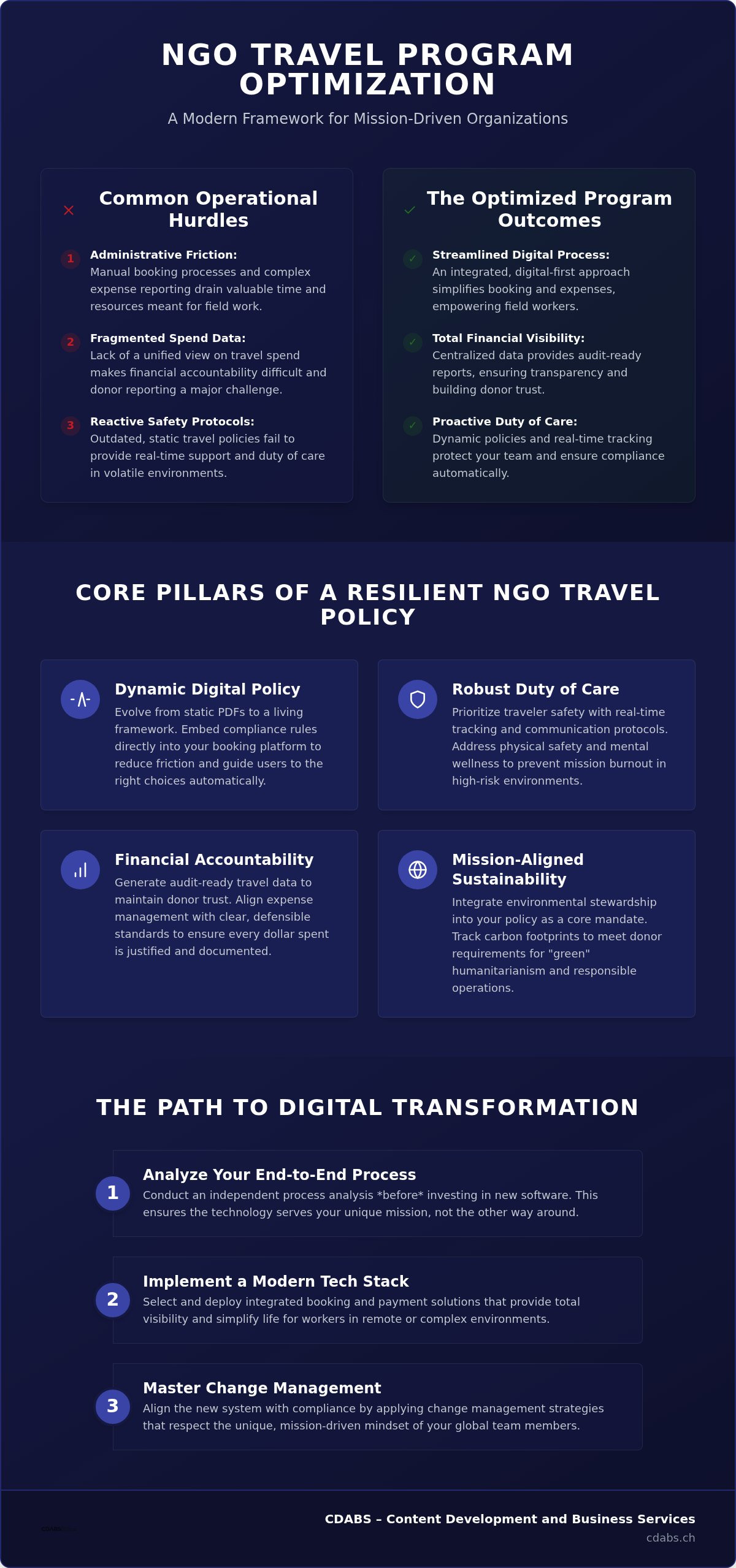
A resilient policy is the bedrock of any successful mission. Static PDFs are relics of the past. Modern NGO travel program optimization relies on dynamic, digital rules that live within your booking platform. These rules ensure compliance automatically, reducing the friction that field teams often face. By embedding policy directly into the workflow, you protect your staff without forcing them to navigate buried appendices or complex manuals. It's a pragmatic way to maintain control while empowering your team in the field.
Sustainability has also moved from a "nice to have" to a donor mandate. Tracking carbon footprints is now a standard requirement for "green" humanitarianism. Your policy must define how to balance essential travel with environmental stewardship. Integrating these pillars into a single framework creates a steady, reliable operation that reassures partners and donors alike. This comprehensive oversight is what distinguishes a modernized program from one that's merely surviving.
Duty of Care in High-Risk Environments
Safety is paramount. Real-time traveler tracking and robust communication protocols are no longer optional. Beyond physical safety, your policy should address "mission burnout" by incorporating mental health and wellness support. For those on spiritual missions, providing access to resources like Make Disciples can be a vital component of this support, offering ministry training and spiritual development tools that help sustain their purpose in the field. For Swiss-based NGOs, there are specific legal requirements regarding the protection of employees operating internationally. A well-structured policy acts as a strategic architect for safety, ensuring that duty of care is a lived reality rather than a checkbox. This approach fosters a sense of security that allows your team to focus on their critical work.
Transparency is the currency of the non-profit sector. Creating audit-ready travel data is essential for maintaining trust. Your expense management should align with standards like the IRS accountable plan rules to ensure every reimbursement is justified and documented. Managing per diems in remote locations requires a hands-on facilitator who understands local complexities and payment challenges. Optimizing supplier negotiations for non-profit rates further stretches every franc or dollar. If your current policy feels fragmented, it might be time to review your strategic framework to ensure it meets the demands of 2026 and provides the transparency your donors expect.
Digital Transformation and Modern Payment Solutions
Digital transformation serves as the essential framework for organizational efficiency. It's not merely about replacing paper with screens; it's about re-engineering the entire lifecycle of a trip. By 2026, a robust tech stack for non-profits must include automated approval workflows that eliminate administrative bottlenecks. These systems allow managers to focus on strategic growth rather than chasing signatures. Data-driven insights from travel analytics now empower leaders to forecast future needs with precision, ensuring that NGO travel program optimization is rooted in evidence rather than intuition.
Modernization also means moving beyond legacy systems that were never designed for the complexity of humanitarian work. A streamlined, digital-first approach allows for a seamless integration of new systems into your existing operations. This methodical oversight ensures that no detail is lost as you transition to more sophisticated tools. It's a pragmatic step toward maintaining a healthy, resilient organization that can withstand the pressures of a shifting global environment.
Optimizing Corporate Travel Payments
Transactions in the field often present the highest risk. Virtual cards have emerged as a secure alternative to carrying large amounts of cash in volatile regions. They offer immediate visibility and can be restricted to specific categories or dates. For unbanked or remote areas, modern payment platforms help solve the per diem challenge by providing digital wallets that function without traditional infrastructure. Centralized billing further streamlines the process by reducing the sheer volume of individual expense reports that your finance team must reconcile. This hands-on facilitation of payment logic reduces the administrative burden on your most valuable assets: your people.
Implementing Global Travel Management Solutions
Successful implementation requires tools that understand the unique nature of humanitarian work. Standard software often struggles with multi-stop, complex routes typical of field operations. You need a solution that prioritizes mobile-first accessibility, as field workers often rely on limited connectivity. This digital-first approach ensures that your team remains connected and supported, regardless of their location. To understand how to build this foundation, see our Digital Transformation for Business Travel: The 2026 Strategic Roadmap. Strategic architecting of your tech stack ensures that NGO travel program optimization delivers tangible results for your mission.
Change Management: Aligning Mission with Compliance
Even the most advanced NGO travel program optimization efforts fail if the human element is ignored. It's a common oversight to assume that a better tool will automatically lead to better results. In reality, the success of any transition depends on how well your team adopts the new system. Without a structured change management strategy, new digital tools often become expensive shelfware. A methodical approach ensures that your staff understands the value of the transition, moving from skepticism to active support.
NGO employees often possess a "mission-first" mindset. They view administrative tasks as a distraction from their core humanitarian work. If a new centralized policy feels like a bureaucratic hurdle, they'll find ways to bypass it. Overcoming this resistance requires a strategy that frames compliance as a mission-enabler rather than a constraint. It's about demonstrating that a streamlined process actually frees up more time and resources for the field. An independent consultant acts as a vital facilitator in this process, bridging the gap between headquarters and remote field offices with a calm, controlled perspective.
Bespoke Communications Packages
Tailoring the message is critical. You must explain "why" the change benefits the mission in a language that resonates with field workers. Generic corporate announcements often fall flat in a non-profit environment. Using internal influencers to champion travel program updates can effectively bridge the gap between policy and practice. These champions help translate complex technical changes into relatable benefits for their peers. For a deeper dive into this process, review our Strategic Change Management for Corporate Travel: A 2026 Framework. Clear, consistent communication is the foundation of organizational health during any transition.
Continuous Education and Masterclasses
Training shouldn't be a one-time event. Field teams need ongoing support to master new technologies and safety protocols, especially in high-risk environments. Simultaneously, executive-level education is necessary to highlight the strategic value of travel data for donor reporting. This dual approach fosters a culture of fiscal responsibility and travel safety across the entire organization. By investing in continuous learning, you ensure that your travel program remains resilient and adaptable to future challenges. To ensure your team is fully aligned with your organizational objectives, consider our Change Management Communications Packages to facilitate a smooth and professional transition.
Partnering for Success: The CDABS Optimization Framework
NGO travel program optimization isn't a one-off administrative task. It's a continuous commitment to your organization's operational health. CDABS approaches this through a methodical end-to-end analysis. We don't just look at booking tools; we audit the entire workflow from the initial request to final donor reporting. This comprehensive oversight ensures that every part of the travel lifecycle is optimized for both efficiency and mission alignment. It's about building a structure that supports your team's vital work without unnecessary complications.
Dominic Short brings over 30 years of cross-sector experience to every project. This longevity provides a steady perspective that's rare in a fast-moving industry. By functioning as a strategic architect, CDABS helps you navigate complex transitions without the burden of permanent agency overhead. You get the elite expertise of a veteran consultant on a project basis. This ensures your resources stay focused on the field rather than on administrative bloat. It's a pragmatic way to modernize while remaining a lean, mission-focused entity.
From Process Analysis to Implementation
A successful overhaul follows a clear roadmap. We start by identifying the specific needs of your organization; then we move to selecting and implementing the right global travel management solutions. Success is measured through specific KPIs, such as a reduction in manual processing time and improved duty of care compliance. Because CDABS is an independent consultancy and not a Travel Management Company (TMC), our advice is entirely unbiased. We represent your interests, not the supplier's. This independence is crucial for ensuring that the systems you adopt are the best fit for your unique humanitarian requirements.
Getting Started with a Travel Audit
The first step is often the most impactful. A travel audit identifies "low-hanging fruit," which are immediate areas where you can save costs or reduce friction without major structural changes. From there, we build a long-term digital roadmap that prepares your organization for the next decade of global mobility. It's about creating a stable, future-proof infrastructure that can handle geopolitical shifts and donor demands. If you're ready to move beyond fragmented legacy systems and build a more resilient program, contact CDABS to discuss your NGO's travel transformation today. We'll work together to ensure your travel program is as dedicated to your mission as your team is.
Securing the Future of Global Humanitarian Mobility
The landscape of 2026 demands more than legacy systems and fragmented policies. Successful NGO travel program optimization requires a shift toward a resilient, digital-first infrastructure that prioritizes traveler safety while satisfying donor transparency. By integrating dynamic policies with automated payment solutions, you can eliminate administrative friction and ensure every franc directly supports the field. It's about moving from reactive logistics to a proactive strategy that protects your most valuable assets: your mission and your people.
Navigating this complex transition requires a steady, experienced hand to guide the way. With over 30 years of business travel expertise, CDABS provides independent, technology-agnostic advice tailored specifically to the unique needs of the non-profit sector. We offer specialized change management communications packages to ensure your global team is aligned and empowered throughout every stage of the process. Optimize your NGO travel program with CDABS consulting to build a sustainable, future-proof roadmap for the years ahead. Your mission is critical. Your travel program should be just as resilient and dedicated to that cause.
Frequently Asked Questions
What is NGO travel program optimization?
It is the strategic alignment of an organization's travel logistics, technology, and policy with its core mission. This process ensures that field operations remain efficient while maintaining strict fiscal accountability to donors. By analyzing end-to-end workflows, organizations can reduce manual administrative burdens. Effective NGO travel program optimization results in a resilient infrastructure that protects travelers and maximizes the impact of every franc spent on global mobility.
How does NGO travel management differ from corporate travel?
NGO travel management focuses on the "last mile" of humanitarian work in remote or high-risk areas rather than standard business hubs. While corporate travel prioritizes comfort and proximity to offices, non-profit travel must balance safety with extreme cost sensitivity. It involves complex, multi-stop routes and unique payment challenges in unbanked regions. These programs require a mission-first approach that respects the specific values and limited budgets of the humanitarian sector.
Can a smaller NGO benefit from travel management consulting?
Smaller organizations often gain the most from independent consulting because they lack dedicated internal travel departments. A consultant acts as a strategic architect to identify "low-hanging fruit" for immediate cost savings. This project-based support provides elite expertise without the overhead of a permanent agency. It allows smaller teams to implement sophisticated digital tools that were previously only accessible to larger global entities, ensuring they remain lean and efficient.
What are the most common challenges in non-profit travel logistics?
The primary challenges include fragmented spend visibility, manual booking processes, and high friction for field workers in remote locations. Many organizations struggle with mission burnout and safety concerns in volatile regions. Additionally, meeting donor requirements for transparent reporting and carbon tracking adds administrative complexity. Balancing these operational needs with fiscal constraints requires a methodical approach to process analysis and the seamless integration of modern travel management solutions.
How can we improve duty of care for field workers in remote areas?
Improving duty of care starts with implementing real-time traveler tracking and robust communication protocols. You should move away from static PDF policies toward dynamic, digital rules that provide immediate support during disruptions. Addressing mental health and wellness is also critical for teams operating in high-stress environments; for instance, providing access to creative movement research at hubs like Bluebox (to see their programs, click here) can be a vital part of a holistic wellness strategy. A well-structured policy ensures that safety is embedded into every booking, providing a steady, reliable hand for staff working on the front lines.
Investing in a digital-first approach is essential for long-term organizational health and efficiency. Manual processes are time-consuming and prone to errors, often leading to a lack of visibility into total travel spend. A modern system automates approval workflows and provides data-driven insights for better forecasting. This transition is a foundational step in NGO travel program optimization, allowing your team to focus on mission-critical outcomes rather than administrative tasks.
How do virtual payment solutions help NGO travel programs?
Virtual payment solutions provide secure field transactions without the risks associated with carrying large amounts of cash. They offer centralized billing, which significantly reduces the volume of individual expense reports for your finance team. In unbanked or remote regions, digital wallets help solve the per diem challenge by providing workers with accessible funds. This technology ensures transparency for donors and simplifies the reimbursement process for staff working in complex environments.
What role does change management play in travel optimization?
Change management is the facilitator that ensures your team actually adopts new tools and policies. Without a clear communication strategy, mission-driven employees may resist centralized systems that feel like bureaucratic hurdles. It involves explaining the "why" behind the change and training staff on new technologies. Effective change management bridges the gap between headquarters and the field, fostering a culture of safety, fiscal responsibility, and operational excellence.


Comments