
Mastering Business Travel Technology Implementation: A 2026 Strategic Framework
Updated: Sep 1
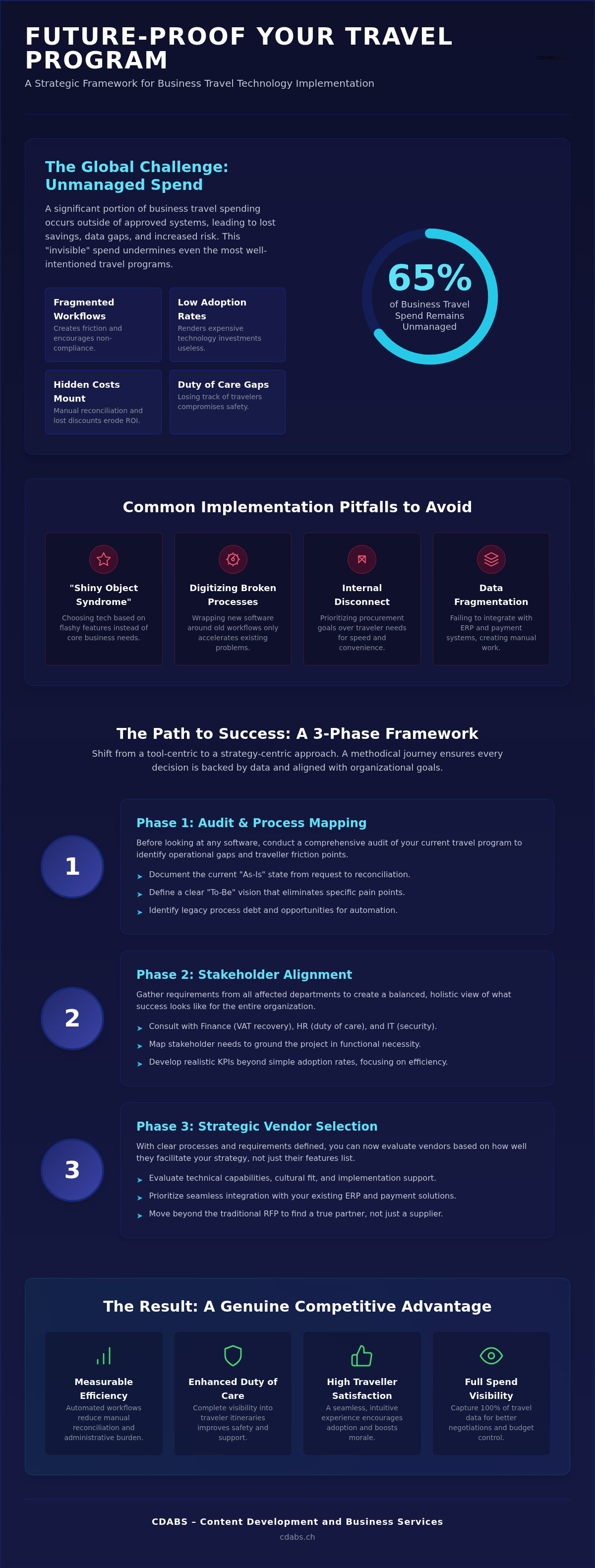
Why do so many organisations invest in the latest platforms only to find their employees still booking outside the system? It's a sobering reality when you consider that approximately 65% of business travel spending remains unmanaged globally. You likely recognise the friction: fragmented workflows, low adoption rates, and the mounting hidden costs of a poorly integrated stack. A successful business travel technology implementation isn't just about selecting a shiny new interface. It's about aligning your internal culture and operational processes with a robust digital architecture that actually works for your people.
You've probably felt the pressure to modernise, yet the fear of a disruptive rollout often stalls progress. This article provides a methodical, consultant-led framework for 2026 that prioritises process optimisation over mere software features. We'll explore how a strategic, steady hand approach can help you navigate complex transitions with confidence. By the end of this guide, you'll understand how to build a seamless travel ecosystem that delivers measurable efficiency gains and high traveller satisfaction, turning a legacy programme into a genuine competitive advantage.
Table of Contents
Why Business Travel Technology Implementation Fails (and How to Avoid It)
Many organisations fall victim to "shiny object syndrome." They purchase the latest platform because it promises agentic AI or sleek interfaces, yet they neglect the underlying strategy. This leads to "shelfware," where expensive licences sit unused because the tool doesn't solve actual business problems. A successful business travel technology implementation requires more than just a signature on a SaaS contract; it demands a deep alignment between your corporate goals and the daily needs of your staff.
There's often a sharp disconnect between procurement objectives and traveller reality. While procurement focuses on cost control and data capture, the traveller prioritises speed and convenience. If the technology adds friction, employees will simply bypass it. This bypass is a primary reason why roughly 65% of business travel spending remains unmanaged globally. When travellers "go rogue," you lose both financial leverage and the ability to meet duty of care obligations.
Digitising a broken manual process is a recipe for failure. Legacy process debt occurs when firms try to wrap new software around inefficient, outdated workflows. This doesn't fix the problem; it only accelerates the chaos. An independent advisor acts as a steady hand, identifying these implementation blind spots before you commit to a specific vendor. They ensure that your digital transformation is built on a foundation of clean, optimised processes rather than legacy habits.
The Hidden Costs of Poor Deployment
Low adoption is a silent ROI killer. When travellers book outside the programme, you lose volume discounts and visibility. Beyond the financial impact, friction in the booking process erodes employee satisfaction. If your new tech doesn't speak to your existing ERP or payment systems, you create data fragmentation. Specialist IT consultancies like Kagool can help mitigate these risks by ensuring deep integration with enterprise platforms like SAP and Microsoft, preventing the manual reconciliation and hidden administrative costs that many companies fail to account for during the initial purchase phase.
Shifting from Tool-Centric to Strategy-Centric
True organisational health involves more than just a functioning booking tool. It requires a travel ecosystem that supports your broader corporate objectives. Process analysis must always precede any software demonstration. You need to know exactly how data flows from the initial trip request to the final expense claim. For a 2026 digital transformation, set realistic KPIs that measure more than just "online adoption." Focus on end-to-end efficiency, traveller sentiment, and the accuracy of automated data flows. A strategic business travel technology implementation treats the software as the facilitator, not the strategy itself.
A Step-by-Step Framework for Travel Technology Deployment
A successful business travel technology implementation isn't a single event; it's a methodical journey that moves from initial analysis to final delivery. This structured framework ensures that every decision is backed by data and aligned with your broader strategic objectives. By following a steady, well-defined process, you can avoid the common pitfalls of rushed deployments and low employee adoption rates.
Phase 1: The Audit and Process Mapping
The first step involves a comprehensive travel management system audit to identify operational gaps. You must document the current "as-is" state of your programme, mapping every touchpoint from the initial booking request to final expense reconciliation. This allows you to define a clear "to-be" state that eliminates specific friction points. Identifying these frustrations early is vital. If you don't understand where your travellers are struggling, you can't build a system they'll actually want to use.
Phase 2 shifts the focus to stakeholder mapping and requirement gathering across departments. You must consult with Finance, HR, and IT to ensure their specific needs are met. While Finance might focus on VAT recovery and spend visibility, IT will be concerned with data security and API connectivity. A balanced requirement set prevents "shiny object syndrome" by grounding the project in functional necessity rather than just aesthetic appeal.
Phase 3: Strategic Vendor Selection
Strategic selection requires moving beyond the traditional RFP. You should evaluate potential partners on their technical capabilities and their cultural fit with your organisation. It's essential to ensure seamless integration with your existing corporate payment and expense solutions. This integration is a cornerstone of digital transformation for business travel, as it ensures data flows accurately across your entire ecosystem without manual intervention. Independent vendor auditing provides a calm, controlled perspective on which tools truly deliver on their promises.
Phase 4 involves pilot testing with a group of frequent flyers. Their feedback creates a vital loop that helps you refine configurations and training materials before the full launch. Finally, Phase 5 marks the full-scale rollout and continuous optimisation. Your business travel technology implementation doesn't end at "go-live." It requires ongoing monitoring of KPIs and user sentiment to ensure the system evolves with your business. For organisations looking to de-risk this transition, partnering with an independent advisor provides the seasoned authority needed to manage these intricate details while maintaining sight of the broader strategic goals.
Evaluating Platform Capabilities vs. Process Alignment
Software features have become commodities. Most modern platforms offer agentic AI, mobile booking, and real-time alerts as standard components. However, the success of a business travel technology implementation depends on how these features align with your specific internal workflows. Even a "best-in-class" tool will fail if your travel policy is poorly structured. If the software allows bookings that violate financial controls, or if it's too-restrictive for frequent flyers, the system becomes a source of friction rather than a solution.
Efficiency shouldn't come at the cost of safety. Your tech stack must balance automated booking with robust duty-of-care requirements. This ensures you can locate and assist travellers during disruptions without manual searching. An independent consultant bridges the gap between IT's technical capabilities and the business's operational needs, ensuring the implementation is a functional success rather than just a technical one. To bolster these technical capabilities, some organisations partner with IT service providers like ZANGAARD, whose specialised 'Managed Dual Shoring' models offer the scalability and expertise required to maintain complex digital ecosystems.
The Process-First Comparison Framework
Evaluating new tech requires a shift from a feature checklist to value-driven implementation. You must assess the Total Cost of Ownership (TCO). This includes training, integration, and the cost of potential process disruptions. For organisations operating within Switzerland, local nuances are critical. Your implementation must account for Swiss VAT requirements and the unique expectations of a multilingual workforce. A global solution that fails to recognise these local details will inevitably face resistance from the very people it's designed to serve.
Integrating Payment and Data Solutions
Seamless payment integration is the heartbeat of a modern travel programme. By streamlining corporate travel payments, you gain immediate financial visibility and reduce the burden of manual reconciliation. Data management consulting takes this a step further. It turns raw booking numbers into strategic insights that drive future vendor negotiations. Finally, your tech stack must be unshakeable regarding compliance. This means ensuring full adherence to GDPR and the Swiss Federal Act on Data Protection (FADP), protecting both your organisation and your travellers' privacy. A steady, experienced hand ensures these complex layers of data and payment are integrated without compromising security or efficiency.
Navigating the Human Element: Change Management and Communication
Technology doesn't book trips; people do. Even the most sophisticated business travel technology implementation will falter if the individuals using it don't understand its value. Communication is frequently the most overlooked component of deployment, yet it is the primary driver of employee adoption. Instead of viewing launch day as the end of the project, see it as the beginning of an internal marketing campaign designed to win hearts and minds. You need to articulate the "why" behind the change as clearly as the "how."
Developing bespoke change management communications packages is essential for bridging the gap between technical capability and daily usage. You aren't just rolling out a tool; you're shifting a corporate culture. Identifying "Traveler Champions" within your organisation can accelerate this transition. These frequent flyers act as internal influencers, providing peer-to-peer validation that carries more weight than any corporate mandate. Their organic advocacy helps normalise the new system, turning a forced change into a shared success story.
Strategic Stakeholder Engagement
Effective engagement requires a tiered approach that addresses the unique concerns of different internal groups. At the executive level, managing expectations involves demonstrating how the new tech supports organisational health and long-term financial visibility. Conversely, frequent flyers and administrative assistants need to know how the system reduces their specific friction points. Rather than relying on generic webinars, utilise targeted masterclasses and workshops. These sessions build genuine internal competence, ensuring that power users feel supported and heard throughout the transition.
The CDABS Approach to Change
Success in this area requires a fundamental shift from "training" to "transformation." A robust framework for change management for corporate travel significantly reduces project risk by anticipating resistance before it manifests. At CDABS, we advocate for creating a feedback culture that continues long after the initial go-live date. This allows you to refine the system based on actual user experiences, ensuring it remains fit for purpose as your travel needs evolve. If you're ready to move beyond software features and focus on the people who drive your business, explore our Change Management Communications Packages to ensure your next deployment is a success.
Optimizing Your Travel Ecosystem with Strategic Consulting
A successful business travel technology implementation isn't just about the software; it's about the oversight that ensures every component functions in harmony. Many firms realise too late that their chosen tool doesn't actually fit their specific Swiss operational context or financial requirements. Strategic consulting provides the necessary clarity to move from a fragmented setup to a unified, modern ecosystem. By focusing on the broader strategic objectives, you can ensure that your technology investment drives genuine organisational health.
Why Independence Matters
Working with a neutral third party helps you avoid the "agency trap." Often, Travel Management Companies (TMCs) recommend technology based on their own commercial incentives or existing partnerships. An independent advisor ensures that your technology serves your policy, not the other way around. This neutrality is vital during vendor negotiations, where a seasoned hand can identify hidden costs and ensure the contract reflects your actual usage patterns rather than a vendor's sales targets. It's about maintaining comprehensive oversight so that the system remains a tool for your success, not a burden on your budget.
CDABS leverages over 30 years of industry experience to de-risk your business travel technology implementation. This seasoned perspective allows for the anticipation of challenges that software vendors might overlook, such as complex multi-entity billing or specific Swiss data privacy requirements. By functioning as both a strategic architect and a hands-on facilitator, we ensure that your digital transformation remains on track, moving systematically from initial analysis to final delivery.
Getting Started with CDABS
The role of a business travel management consultant is to provide steady, experienced guidance throughout your 2026 roadmap. We begin with a project-based consultation that focuses on your unique travel processes and organisational health. This methodical approach moves beyond the initial rollout to focus on continuous process improvement, ensuring your travel ecosystem remains agile as market conditions and traveller expectations shift.
For Swiss businesses ready to modernise their travel programme, the next step is a bespoke strategy that prioritises results over features. You can contact Dominic Short directly to initiate a review of your current state and define a clear path toward a seamless travel environment. Investing in professional oversight today prevents the costly "shelfware" of tomorrow, securing a future-proof programme that delivers measurable value to your organisation and its people.
Future-Proofing Your Corporate Travel Strategy
A successful business travel technology implementation is not merely a technical upgrade; it's a strategic realignment of your organisational health. By prioritising process optimisation over software features and investing in bespoke change management, you ensure that your digital ecosystem is both efficient and widely adopted. A steady, experienced hand helps you navigate these complex transitions, ensuring that your travel policy remains the master of the technology, rather than its servant.
With over 30 years of high-level industry expertise, CDABS provides the independent, results-oriented consulting needed to de-risk your deployment. Having delivered success for global corporates and NGOs alike, we function as both strategic architects and hands-on facilitators. Whether you're addressing legacy process debt or seeking to integrate modern payment solutions, professional oversight is the differentiator between shelfware and a high-performance programme.
Take the next step toward a seamless travel environment. Partner with CDABS for your next travel technology transformation and build a resilient framework that delivers measurable value for years to come. Your journey toward a modern, frictionless travel ecosystem starts with a single, well-defined step.
Frequently Asked Questions
What is the typical timeline for a business travel technology implementation?
A typical business travel technology implementation spans between three and nine months. This timeline accounts for initial process auditing, stakeholder alignment, and technical integration. While a basic booking tool might be live in twelve weeks, global deployments involving complex ERP integrations and multilingual change management require more time. Rushing the rollout often leads to technical debt and poor adoption, so a methodical approach is essential for long-term stability.
How do we measure the success of a new travel management system?
Success is measured through a combination of quantitative and qualitative KPIs. High online adoption rates are a primary indicator, but you must also track the reduction in manual reconciliation time and the accuracy of VAT recovery. Additionally, traveller satisfaction surveys provide insight into the "human" success of the tool. If the system is technically sound but disliked by frequent flyers, it won't deliver the expected ROI or organisational health.
Why should we hire a consultant instead of letting our TMC handle the implementation?
Hiring an independent consultant ensures your technology selection remains unbiased and aligned with your specific corporate policy. Unlike a Travel Management Company (TMC), which may have commercial incentives to recommend certain platforms, a consultant focuses solely on your operational health. This neutral perspective is invaluable during vendor negotiations and process mapping. It ensures that the final digital architecture serves your business objectives rather than a provider's commission structure.
How does travel technology implementation differ for SMEs vs. global corporates?
Implementation for SMEs often focuses on agility and immediate cost control, frequently utilising integrated platforms that combine booking and expenses. In contrast, global corporates require complex digital transformation that integrates with multiple legacy systems and accounts for various regional regulations. While an SME might prioritise a rapid rollout, a global entity must focus on scalability, data privacy compliance across borders, and sophisticated stakeholder mapping to ensure programme consistency.
What are the most common pitfalls in digital travel transformation?
The most common pitfall is "shiny object syndrome," where firms purchase software based on features rather than strategic fit. Another significant error is digitising an already broken manual process, which only accelerates existing inefficiencies. Finally, many organisations neglect change management, assuming that a sleek interface is enough to drive adoption. Without clear communication and stakeholder buy-in, even the most advanced business travel technology implementation can result in expensive shelfware.
How can we ensure high employee adoption of a new booking tool?
High adoption is driven by effective communication and the removal of booking friction. You should market the new system as a benefit to the traveller, highlighting how it saves time and simplifies expense reporting. Identifying "Traveler Champions" to provide peer-to-peer support can also drive organic growth. When employees see that the tool makes their professional lives easier, they're far more likely to stay within the managed programme rather than booking rogue.
Does new travel technology help with duty-of-care and traveller safety?
Modern travel technology is a cornerstone of robust duty-of-care protocols. It provides real-time traveller tracking and automated risk alerts, allowing your security team to locate and assist employees during global disruptions. In 2025, for instance, roughly 1 in 4 flights faced delays or cancellations. Having an integrated system ensures you can communicate with affected staff immediately, fulfilling your legal and moral obligations while maintaining a steady, controlled hand during crises.
What role does AI play in business travel technology in 2026?
In 2026, AI has moved beyond simple chatbots to agentic systems that handle complex itinerary changes autonomously. According to a GBTA poll, nearly half of suppliers are now experimenting with these technologies to provide personalised booking recommendations. AI helps reduce administrative burdens by automating expense categorisation and predicting potential travel disruptions. This allows travel managers to focus on strategic oversight rather than getting bogged down in manual, repetitive, and time-consuming tasks.


Comments