
How to Reduce Business Travel Costs: A Strategic Framework for 2026
Updated: Sep 1
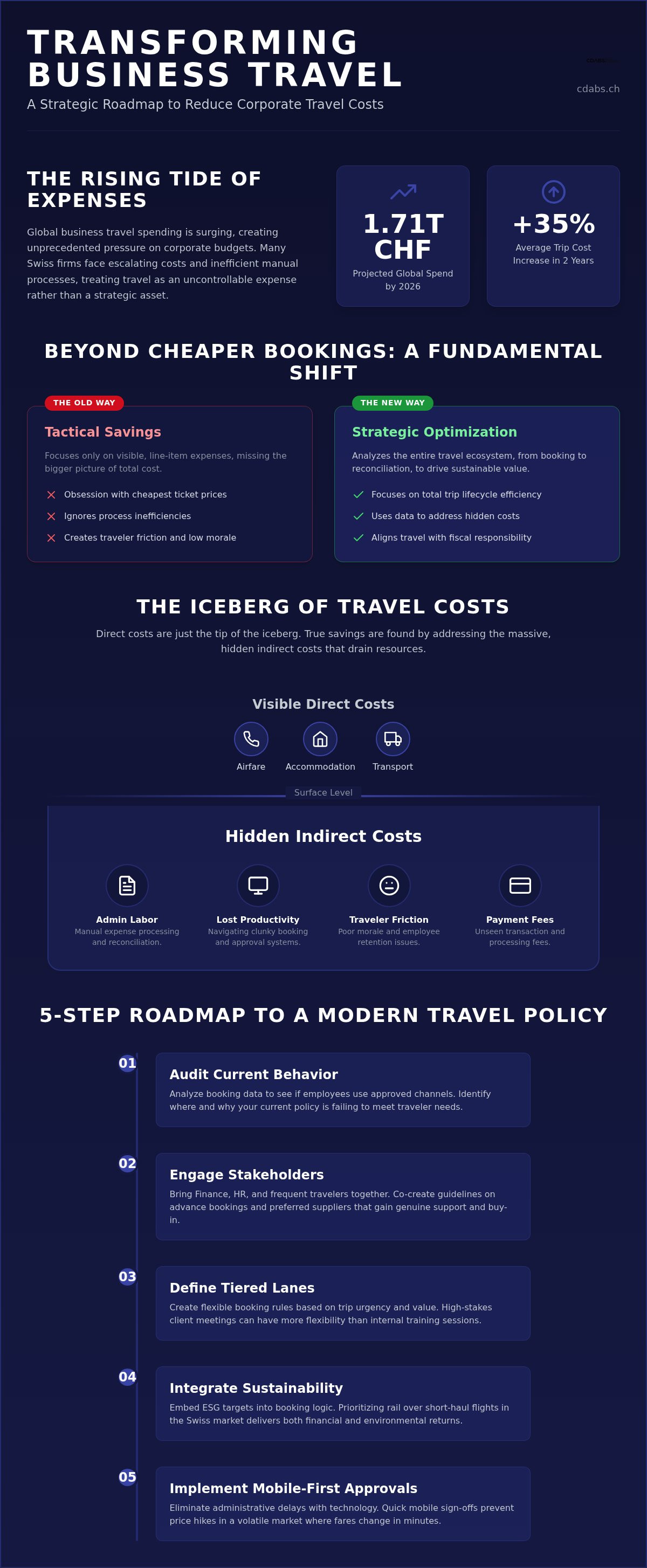
Global business travel spending is projected to reach a record 1.71 trillion CHF in 2026, yet many organizations still treat these expenses as an uncontrollable cost of doing business. If your team is struggling with the 35% increase in average trip costs seen over the last two years, you aren't alone. Many Swiss firms find themselves caught between high operational costs and manual expense processes that lack transparency. You probably recognize that simply booking cheaper flights isn't a sustainable way to manage a budget. True efficiency requires a deeper look at your entire travel ecosystem.
In this article, you'll discover how to reduce business travel costs by transforming your corporate travel from a mounting expense into a streamlined, value-driving asset. We'll provide a clear roadmap for cost reduction that focuses on strategic optimization and digital transformation. You'll learn how to modernize your travel technology and design policies that improve compliance without frustrating your frequent flyers. This framework offers a steady, methodical approach to managing complex transitions and ensuring your travel spend supports your broader organizational health.
Table of Contents
Defining Strategic Cost Reduction in Business Travel
Many leaders mistake "cheaper bookings" for a comprehensive strategy. While securing a budget hotel room might save a few CHF on a single trip, it doesn't address the systemic inefficiencies that drain corporate resources. To understand how to reduce business travel costs, we must look beyond the line item on a receipt. Strategic optimization focuses on process efficiency, whereas tactical savings only scratch the surface of the total spend. It's about looking at the entire lifecycle of a trip from the initial request to the final VAT reclamation.
Current trends in business travel suggest that organizations are increasingly adopting a "Travel Hierarchy." This framework encourages teams to evaluate the necessity of a trip before it's even booked. In a post-digital world, the most significant cost reduction often comes from avoiding low-value travel or substituting it with high-quality virtual collaboration. However, when travel is essential, you cannot manage what you don't measure. Establishing a data-driven baseline is the first step in any successful optimization project. Without accurate spend visibility, your efforts remain guesswork.
Direct vs. Indirect Travel Expenses
Direct costs are the visible expenses: airfare, accommodation, and ground transport. These are easy to track but only tell half the story. Indirect costs often carry a heavier burden for Swiss SMEs and NGOs. These include administrative labor for manual expense processing, payment processing fees, and the lost productivity of employees navigating clunky booking systems. To manage these complex overheads, many organizations utilize the senior-level finance support of CBCS to ensure fiscal efficiency. Identifying these hidden leaks is essential when learning how to reduce business travel costs at scale. There is also the hidden cost of traveler friction. When policies are overly restrictive or systems are difficult to use, it impacts employee retention and morale. High turnover in the Swiss market is far more expensive than a slightly higher hotel rate.
The ROI of Professional Travel Consulting
Working with an independent consultant provides a level of oversight that traditional Travel Management Companies (TMCs) might miss. Because an independent advisor isn't biased by agency commissions, they can identify gaps in your technology stack or payment workflows that currently leak capital. This steady hand helps you navigate complex transitions without disrupting operations. This shift moves your travel department from a cost-center mindset to a value-contribution model. Strategic Travel Management is the alignment of corporate mobility with fiscal responsibility.
Modernizing Your Corporate Travel Policy for Maximum Compliance
A policy is only as effective as its adoption rate. Many organizations find that their guidelines are outdated, failing to account for 2026 market realities or the shift toward digital-first workflows. To understand how to reduce business travel costs, you must first bridge the gap between corporate rules and traveler behavior. A modernized policy does more than set price caps. It creates a culture of accountability and ensures every CHF spent aligns with your strategic objectives.
To build a framework that actually works, follow this methodical progression:
Audit current behavior: Analyze whether your employees are booking through approved channels or finding alternatives. This data reveals where your current policy is failing to meet traveler needs.
Engage stakeholders: Bring together representatives from Finance, HR, and your most frequent travelers. Strategic guidelines help you save money on business travel by focusing on advance booking windows and preferred supplier logic that stakeholders actually support.
Define tiered lanes: Create different booking "lanes" based on the urgency and impact of the trip. High-value client meetings might allow for more flexibility, while internal training sessions follow stricter cost controls.
Integrate sustainability: Embed ESG targets directly into the booking logic. In the Swiss market, prioritizing rail travel over short-haul flights often yields both financial and environmental savings.
Implement mobile-first approvals: Use technology to eliminate bottlenecks. In a volatile market where seat prices can fluctuate by hundreds of CHF in minutes, a quick mobile sign-off prevents price hikes caused by administrative delays.
Designing for Compliance, Not Just Control
Restrictive policies often backfire. When travelers feel trapped by rigid rules, they "book around" the system. This erodes your visibility and negotiating power. Instead of relying solely on penalties, use incentives to encourage cost-conscious behavior. Clear communication is the "missing link" here. If you need support in structuring these complex transitions, business travel management consulting can provide the steady hand required to align policy with practice. When employees understand the "why" behind the rules, they're more likely to follow them.
Tailoring Policies for SMEs and NGOs
Smaller organizations and NGOs often lack the volume to demand massive discounts from global suppliers. However, they can leverage their agility to find savings. For Swiss NGOs, managing donor-restricted budgets requires precise tracking and absolute compliance. Balancing duty of care with lean budgets is a delicate process. By implementing automated workflows and clear "lanes," these organizations can demonstrate how to reduce business travel costs while maintaining their commitment to their mission and their people.
Leveraging Digital Transformation and Payment Solutions
Digital transformation is often misunderstood as a simple software upgrade. In reality, it's the architectural backbone of a modern travel program. A well-defined digital roadmap allows you to identify a technology stack that matches your organizational scale, preventing the "feature creep" that often inflates budgets. By 2026, the shift toward "invisible" expense management has become a standard. Automation now handles the repetitive tasks that once required hours of manual oversight. When you utilize data analytics to identify "leakage," you gain the leverage needed to negotiate better vendor contracts with airlines and hotel chains. This is a primary driver in how to reduce business travel costs without sacrificing service quality.
Optimizing Corporate Travel Payments
Traditional reimbursement models are notoriously inefficient. They place a heavy administrative burden on both the traveler and the finance department. Transitioning to virtual cards and central billing solutions effectively eliminates the need for employees to use personal credit cards for business expenses. This change does more than improve the employee experience; it provides real-time visibility into spend. Automated reconciliation can save your finance team hundreds of man-hours every year, allowing them to focus on higher-value tasks. In Switzerland, precise payment data is also critical for maximizing VAT recovery and ensuring tax compliance across different jurisdictions.
Implementing Global Travel Management Solutions
Selecting the right Online Booking Tool (OBT) is a pivotal decision for any organization with a national or international workforce. The tool must be intuitive enough for high adoption but robust enough to enforce your complex policy "lanes." Seamless integration between your travel software and existing ERP systems ensures that data flows accurately across the organization. This connectivity is vital for maintaining a single source of truth for all travel-related financial data. A transformation advisor plays a crucial role here, providing the steady perspective needed during software selection and implementation. This methodical approach is the most reliable way to understand how to reduce business travel costs through technical excellence. If you are ready to modernize your stack, global travel management solutions implementation provides the framework needed for a successful transition.
Tactical Implementation: Ground Transport and Event Logistics
In Switzerland, the national rail network is a premier asset for any corporate traveler. Encouraging rail travel for domestic routes often saves a substantial amount of CHF compared to car rentals or short-haul flights. It's a pragmatic choice that balances efficiency with sustainability targets. Integrated rideshare apps and car clubs provide the necessary flexibility for the "last mile" while keeping expenses within your predefined policy lanes. This methodical approach ensures that every leg of the journey is accounted for and optimized for cost.
Strategic Event and Conference Planning
Events and conferences represent another major expenditure that requires a steady, experienced hand. Strategic Meeting Management (SMM) allows you to consolidate this spend and gain significant leverage during venue negotiations. Professional handling of event logistics prevents the common budget overruns associated with poor pre-production planning. Consolidating your travel and event management under a single partner ensures that all logistics are synchronized. This synchronization reduces administrative friction and secures better rates for conferences and incentives. For organizations looking to optimize these complex logistics, professional meeting and conference organization provides the necessary oversight to ensure every event delivers a clear return on investment.
Finally, addressing the cost of internal travel is essential. High-quality virtual meeting integration allows teams to collaborate effectively without the recurring expense of a physical trip. You don't need to eliminate face-to-face contact entirely. Instead, reserve your travel budget for high-impact, external client interactions where physical presence provides the most value. This is a core component of how to reduce business travel costs in a post-digital environment. By prioritizing high-value trips and utilizing technology for routine internal updates, you maintain organizational health while protecting your bottom line.
The CDABS Approach: Turning Strategy into Sustainable ROI
While technology and policy provide the necessary structure, the human element remains the most significant variable in any corporate travel program. Many Swiss organizations invest heavily in sophisticated software but fail to realize the expected ROI because they overlook change management. This is the "missing link" in understanding how to reduce business travel costs effectively. Without a clear strategy to align traveler behavior with organizational goals, even the best systems will face internal resistance. Sustainable savings require more than a new tool; they require a shift in culture.
At CDABS, the approach begins with a comprehensive, end-to-end analysis of your current processes. This isn't a surface-level check. It's a deep dive into the workflows that drive your spend. Dominic Short brings over 30 years of industry experience to this process, acting as a strategic architect who understands the evolution of global travel. This seasoned perspective allows for a calm, controlled transition that addresses both technical requirements and the cultural nuances of your team. This methodical flow ensures that every detail is managed while keeping sight of your broader business objectives.
Change Management for Seamless Digital Change
Engaging stakeholders early is the most reliable way to prevent project failure. When employees feel involved in the selection of new tools, they're more likely to embrace them. Training and education play a pivotal role here. CDABS offers specialized masterclasses for corporate teams to ensure everyone is comfortable with the new digital roadmap. "Technology provides the tools for savings, but change management provides the results." This philosophy ensures that your digital transformation leads to tangible financial benefits rather than just a new set of unused features.
Bespoke Consulting for Global Growth
Scaling travel processes for Swiss companies expanding internationally requires a nuanced understanding of different market conditions and regulations. Choosing an independent, project-based consulting model provides a significant advantage over agency-led models. Because an independent advisor isn't tied to commissions, the focus remains entirely on your organizational health and specific needs. This is a critical factor when learning how to reduce business travel costs while maintaining high standards of duty of care. Bespoke communications packages ensure your team understands the "Why" behind the "How," fostering a culture of compliance that lasts. Optimize your corporate travel with CDABS consulting services and turn your travel program into a streamlined, value-driving asset.
Building a Resilient Travel Program for the Future
Navigating the complexities of corporate mobility in 2026 requires a steady hand and a clear vision. True efficiency isn't found in the cheapest ticket but in the seamless integration of modern technology, robust policy design, and effective change management. By focusing on process optimization and consolidated payment solutions, your organization can reclaim hundreds of administrative hours while gaining absolute visibility into every CHF spent. This is the ultimate blueprint for how to reduce business travel costs while supporting your team's productivity and morale.
CDABS provides the independent, unbiased strategic advice you need to navigate these transitions. With 30 plus years of global travel management expertise, we specialize in tailoring travel programs for Swiss SMEs and NGOs. We understand that technology provides the framework, but people drive the results. It's time to move beyond a cost-center mindset and treat your travel program as a strategic asset that contributes to your organizational health.
Book a consultation with CDABS to optimize your travel strategy and take the first step toward a modernized, cost-effective future. Your journey toward operational excellence starts with a single, well-informed decision.
Frequently Asked Questions
What is the most effective way to reduce business travel costs quickly?
Immediate gains come from enforcing strict advance booking windows and consolidating ground transport. Requiring bookings at least 14 days in advance can capture significantly lower fares before demand spikes. Additionally, eliminating "leakage" by requiring all bookings through a central tool ensures you capture negotiated rates. This provides immediate visibility and prevents the use of expensive, last-minute retail options that drain the corporate budget.
How can SMEs negotiate better rates with travel vendors?
Swiss SMEs can gain leverage by consolidating their spend with a limited number of preferred partners rather than spreading bookings across multiple platforms. Even without massive global volume, showing a hotel or airline that you can move a consistent percentage of your "share of wallet" to them opens doors for corporate discounts. Using a consultant to benchmark your spend against similar Swiss organizations provides the data needed for these negotiations.
Why is a corporate travel policy important for cost control?
A well-defined policy serves as the operational blueprint that prevents overspending and ensures duty of care compliance. It establishes clear "lanes" for different trip types, ensuring that expensive flexible tickets are only used when truly necessary. Without these guidelines, employees often default to the most convenient rather than the most cost-effective options. A policy also streamlines the approval process, preventing delays that lead to higher booking prices.
How does digital transformation impact the business travel budget?
Digital transformation reduces costs by automating manual administrative tasks and providing real-time data for better decision-making. By integrating travel software with your ERP system, you eliminate the labor-intensive process of manual expense reconciliation. This modernization is a key factor in how to reduce business travel costs because it identifies hidden leaks and administrative friction. It shifts the focus from managing receipts to analyzing strategic value.
Can an external consultant really save more than they cost?
Professional consultants typically identify savings that far exceed their fees by uncovering process inefficiencies and unbiased vendor opportunities. Unlike agencies that may rely on commissions, an independent advisor focuses entirely on your bottom line. They bring a seasoned perspective to complex transitions, ensuring that new systems are implemented correctly the first time. This prevents the costly project failures and low adoption rates that often plague unguided digital transitions.
What are the common mistakes companies make when trying to cut travel spend?
The most frequent error is focusing solely on the price of tickets while ignoring the high cost of administrative labor and traveler friction. Overly restrictive policies often drive employees to book outside the system, which destroys visibility and negotiating power. Another mistake is failing to address "internal travel" costs that could be handled via virtual tools. Sustainable reduction requires a balance between lean spending and maintaining employee productivity.
How do payment solutions like virtual cards help reduce travel expenses?
Virtual cards reduce expenses by providing strict control over spending limits and eliminating the risk of unauthorized charges. These tools generate a unique card number for each transaction, which simplifies the reconciliation process and reduces manual labor for finance teams. In the Swiss market, these solutions also improve the accuracy of VAT reclamation. This level of precision is essential for organizations looking at how to reduce business travel costs through technical optimization.
How can we reduce travel costs without affecting employee morale?
Transparency and clear communication are the most effective tools for maintaining morale during cost-reduction initiatives. Instead of simply cutting perks, explain the "why" behind policy changes and involve frequent travelers in the design process. Providing better technology that makes booking easier can actually improve the traveler experience even if the budget is tighter. Using bespoke communications packages ensures that your team feels like partners in the organization's financial health.


Comments