
Digital Transformation for Business Travel: The 2026 Strategic Roadmap
Updated: Sep 1
If you believe that buying the latest travel management software will automatically modernize your corporate program, you are likely setting yourself up for a costly disappointment. True digital transformation for business travel isn't a simple software purchase; it's a rigorous process of change management and system integration. You've probably experienced the frustration of legacy ERP systems clashing with sleek new apps, or perhaps you've seen employee adoption rates stall because the tools feel like a burden rather than a benefit.
It's understandable to feel overwhelmed by the sheer volume of platforms promising to solve every problem. You want a streamlined workflow that provides real-time visibility into every CHF spent, while keeping your travelers satisfied and productive. This 2026 strategic roadmap moves beyond the hype to offer a pragmatic approach to modernization. We will examine how to balance cutting-edge automation with human-centric strategies, ensuring your technology stack works in harmony with your organizational culture. We'll cover everything from data-driven auditing to bespoke communication packages that drive high user engagement and operational excellence across your entire travel ecosystem.
Table of Contents
Defining Digital Transformation for Business Travel in 2026
The era of simple online booking tools is over. By 2026, digital transformation for business travel has evolved into a sophisticated integration of intelligent automation and predictive data. It's no longer enough to just digitize a paper process. Companies must fundamentally rethink how they deliver value to their employees and their bottom line. The old status quo, characterized by manual expense reports and fragmented booking channels, is failing. It creates data gaps that make it impossible to manage costs or ensure traveler safety effectively.
When we look at Defining Digital Transformation, we see it's about using technology to radically improve performance. In corporate travel, this means moving from a reactive stance to a proactive, data-driven strategy. Instead of reviewing spend months after a trip, managers now use real-time insights to adjust policies instantly. This shift ensures that the travel program supports the company's broader objectives rather than just being a line item on a spreadsheet.
The Evolution from Legacy Systems to Ecosystems
Strategic Objectives: Efficiency, Modernization, and Health
Modern KPIs are shifting. While cost control remains important, leading organizations now prioritize process efficiency. They measure how many seconds it takes to file an expense or how often a traveler needs to call a support line. Organizational health in this context is defined as the measurable reduction of administrative friction that detracts from an employee's core professional focus and overall well-being. Achieving this requires a delicate balance. You must provide travelers with enough autonomy to choose their preferred routes while maintaining strict corporate compliance through automated, "invisible" guardrails. This approach ensures that every CHF spent is accounted for without frustrating the people doing the work. This balanced strategy is the hallmark of a successful digital transformation for business travel.
The Three Pillars of a Modernized Travel Program
To execute a successful digital transformation for business travel, you need a stable foundation. We categorize this into three interconnected pillars that move your program from a cost center to a strategic asset. These pillars aren't just for global conglomerates. Swiss SMEs and NGOs find that this structure provides the agility needed to manage limited resources while maintaining high standards of care for their travelers. Without a clear framework, technology implementation often becomes a series of disjointed tools that fail to communicate with each other.
Pillar 1: Data Centralization. This involves turning fragmented booking data into actionable insights. If your data is scattered across different emails and credit card statements, you can't manage what you can't see.
Pillar 2: Payment Solutions. The shift toward virtual cards and automated reconciliation is accelerating. It removes the burden of manual expense claims from the traveler while providing finance teams with instant oversight.
Pillar 3: Policy Automation. Static PDF policies are obsolete. Modern programs use dynamic policies that adapt to market conditions and specific traveler needs in real-time, ensuring compliance without manual policing.
The synergy between these pillars creates a virtuous cycle. Better data leads to smarter policies, and automated payments ensure those policies are followed without constant manual intervention. This holistic approach is the only way to achieve true operational excellence in a complex market. It allows travel managers to step away from administrative firefighting and focus on higher-level strategy.
Optimizing Corporate Travel Payment Solutions
Virtual payment automation is the most significant driver of administrative relief in 2026. By integrating payments directly into the booking workflow, reconciliation happens almost instantly. This eliminates the "leakage" that occurs when employees book outside of approved channels because the payment process is too cumbersome. For Swiss organizations, where precision is paramount, centralized systems ensure every CHF spent is tracked and reconciled against the correct project code. If you're looking to modernize your financial workflows, professional consulting can help bridge the gap between your legacy ERP and modern payment tech.
Data Management and Real-Time Reporting
Real-time visibility is the cornerstone of modern travel management. You can't wait for a quarterly report to discover that your travel spend has spiked. Using live data allows you to negotiate more effectively with suppliers. If you can prove your team spends a specific volume of nights in certain regions, you have the leverage to secure better rates. Clean data is the essential fuel for AI-driven auditing tools. These tools now scan for anomalies and policy violations as they happen, preventing small errors from turning into significant financial losses. This proactive oversight ensures your program remains healthy and compliant without requiring a massive increase in headcount.
Overcoming the Friction of Legacy Processes
Identifying the friction points in your current travel lifecycle is the first step toward meaningful change. These points often manifest as manual data entry, delayed approval chains, and the constant back-and-forth between travelers and finance teams. The cost of inaction is high. It isn't just about the visible administrative expenses; it's about the invisible drain on employee morale. When a senior consultant spends two hours reconciling a complex trip to save 50 CHF, the company has actually lost hundreds of CHF in billable time and contributed to employee burnout.
Technology alone cannot fix a broken process. If you layer a modern booking app over a convoluted approval workflow, you simply create a faster way to be inefficient. Many leaders hesitate because they perceive system migration as an insurmountable complexity. They fear a "big bang" implementation that might disrupt daily operations. However, successful digital transformation for business travel treats migration as a managed evolution rather than a disruptive event. It's about steady, controlled progress that respects the existing business rhythm.
The Human Factor: Change Management in Travel
Industry data suggests that 70% of digital transformations fail due to a lack of stakeholder engagement. It's a sobering statistic that highlights why a top-down mandate rarely works in isolation. To drive internal adoption, we utilize bespoke communications packages that translate technical changes into tangible benefits for the traveler. Transitioning from a "command and control" policy to a user-centric approach empowers employees. It turns them from reluctant users into active participants who value the efficiency of the new system because it actually makes their lives easier.
Bridging the Gap Between IT and Travel
Modern travel technology must align with broader corporate IT and security standards. This is especially critical in Switzerland, where data privacy and cybersecurity are non-negotiable priorities. For organizations navigating these complexities, TechAxis Advisors offers the executive-level guidance needed to align technology and cybersecurity with overall business strategy and operational execution. Managing the transition period requires a strategic choice between running parallel systems or a phased rollout. A digital-first program must ensure that every API connection and data transfer complies with the latest Swiss and international regulations. By involving IT early in the process, you ensure that the travel ecosystem is secure, scalable, and fully integrated into the company's digital architecture. This alignment prevents the "shadow IT" problems that occur when departments buy software without proper oversight.
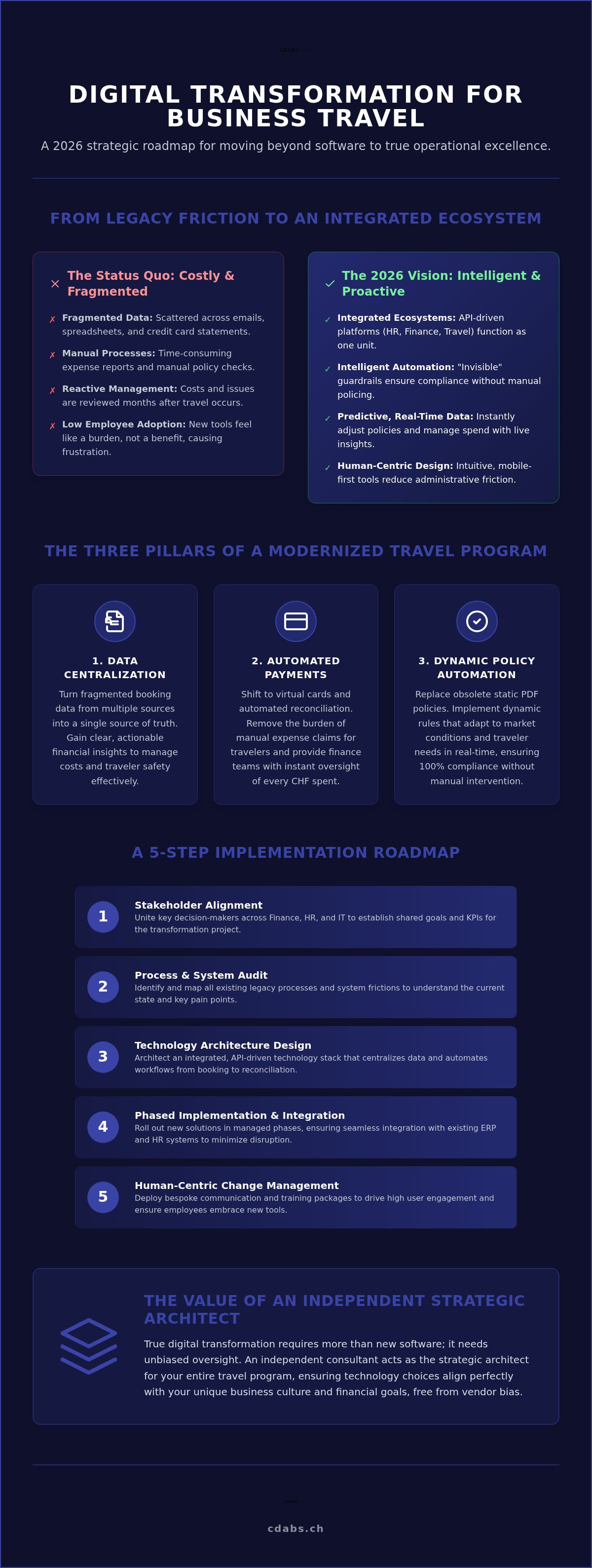
A 5-Step Roadmap for Business Travel Technology Implementation
Implementing a successful digital transformation for business travel requires a structured approach that prioritizes long-term scalability over quick fixes. We've developed a five-step framework designed to guide organizations through this transition with minimal disruption. This roadmap ensures that technology serves the business strategy, rather than the other way around.
Step 1: Process Analysis. Conduct a thorough audit of your current workflows. You cannot modernize what you don't fully measure.
Step 2: Stakeholder Alignment. Secure buy-in from HR, Finance, IT, and your most frequent travelers. Consensus at this stage prevents friction during the rollout.
Step 3: Solution Selection. Evaluate software vendors and Travel Management Companies (TMCs) using an independent framework. Don't settle for the default option provided by your current agency.
Step 4: Pilot and Iterate. Test the new digital workflow with a small, diverse group of frequent flyers. Use their feedback to refine the system before a company-wide launch.
Step 5: Full-Scale Launch. Roll out the program supported by professional change management. Clear communication is the bridge between a new tool and actual employee adoption.
Conducting a Travel Management System Audit
Start with the audit. It's the only way to see where you're actually losing money. Many Swiss firms discover "dark spend," which is travel expenditure that happens outside of official channels and remains untracked until the credit card bill arrives. This often stems from manual workarounds created by employees who find legacy tools too difficult to use. Evaluating the technical debt of these older systems reveals the true cost of inefficiency. By defining the requirements for your "future-state" program now, you ensure the new system solves existing pain points rather than just digitizing them.
Selecting the Right Partners and Platforms
It's vital to separate your technology selection from your agency selection. A TMC might offer a "free" booking tool, but if that tool lacks the integration capabilities your Finance team needs, it will cost you more in the long run. Ask vendors specific questions about their API stability and how they handle automated reconciliation. For growing SMEs and NGOs, scalability is non-negotiable. Your platform must be able to handle an increase in volume without requiring a proportional increase in administrative headcount. If you need an objective perspective on the current vendor landscape, our business travel management consulting services provide the independent oversight necessary to make an informed choice. This independent approach ensures that every CHF invested in your digital transformation for business travel delivers a measurable return on investment.
The Value of Independent Consulting in Digital Change
Many organizations mistakenly turn to their Travel Management Company (TMC) to lead their digital evolution. While TMCs provide essential services, they often face an inherent conflict of interest. Their recommendations may favor proprietary tools or preferred vendors that align with their own revenue streams rather than your specific operational needs. Successfully executing digital transformation for business travel requires an unbiased strategic architect who isn't tied to a single platform or agency.
At CDABS – Content Development and Business Services, we leverage over 30 years of industry experience to provide this independent oversight. We don't just deliver a project; we build a foundation for long-term operational excellence. By acting as a hands-on facilitator, we help you navigate the complexities of global transitions without losing sight of your unique business objectives. Our goal is to ensure that every system integration and policy change serves your company's health and efficiency.
Bespoke Solutions for SMEs, NGOs, and Corporates
Different organizational cultures require different roadmaps. An NGO operating in high-risk regions has vastly different requirements than a Swiss SME looking to optimize domestic rail travel. We customize every digital roadmap to fit these specific contexts. While the technology provides the framework, our approach remains human-centric. We believe that a high-tech environment only succeeds when the people using it feel supported and empowered. CDABS – Content Development and Business Services provides the steady, experienced hand needed to manage large-scale change while maintaining the personal touch that faceless corporate entities often lack.
Your Next Steps Toward Modernization
Your journey begins with an honest assessment of your current digital maturity level. We look at where you are today to determine the most effective path forward. In the first 90 days, we focus on quick wins in travel process optimization that deliver immediate value and build momentum for broader changes. This might involve cleaning up fragmented data or streamlining a single, high-friction approval step. These initial improvements provide the proof of concept needed to secure long-term stakeholder buy-in.
If you're ready to move beyond fragmented legacy systems and embrace a modernized, automated future, we're here to guide the way. Contact CDABS – Content Development and Business Services to begin your digital transformation journey and secure a strategic roadmap tailored to your organization's success.
Transforming Vision into Operational Excellence
Modernizing your travel program is a strategic journey that requires more than just a simple software upgrade. It involves building an integrated ecosystem where data centralization, automated payments, and user-centric policies work in harmony. By moving beyond the friction of legacy processes and following a structured roadmap, you ensure that your organization remains agile, secure, and compliant. This transition isn't just about technical efficiency; it's about fostering an environment where travelers feel supported and spend is clearly visible in real-time.
Achieving a successful digital transformation for business travel requires a steady, experienced hand to navigate the complex technical and cultural shifts involved. With 30+ years of cross-industry expertise, CDABS provides the independent, vendor-neutral advice needed to optimize your processes from end to end. We have a proven track record in driving results that respect your organizational health while protecting every CHF in your budget.
Partner with CDABS for your Strategic Travel Transformation to begin building a more efficient, future-proof travel program today. It's time to turn your travel management into a clear competitive advantage.
Frequently Asked Questions
What is digital transformation for business travel?
Digital transformation for business travel is the deep integration of technology into every stage of the travel lifecycle to change how value is delivered. It moves beyond simple online booking to include automated payments, real-time data auditing, and predictive analytics. This shift turns a reactive cost center into a proactive strategic asset. By 2026, it focuses on creating a seamless ecosystem where traveler needs and corporate compliance are managed through a single, intelligent interface.
How much does it cost to implement new travel technology?
Implementation costs vary significantly based on your organization's size and the complexity of your existing legacy systems. Instead of focusing on a single price tag, consider the total cost of ownership and the potential return on investment. Many Swiss companies find that reducing manual reconciliation and "dark spend" pays for the technology within the first year. It's essential to audit your processes first to ensure you're investing in solutions that solve your specific financial pain points in CHF.
Can digital transformation really reduce corporate travel friction?
Yes, it reduces friction by automating the most tedious aspects of the travel process, such as receipt capture and expense reporting. When your systems communicate through APIs, travelers don't have to navigate multiple apps or wait for manual approvals. This efficiency allows employees to focus on their core professional tasks rather than administrative burdens. Reducing this "travel friction" is a key indicator of organizational health and significantly lowers the risk of employee burnout.
How do I choose between a TMC and an independent travel consultant?
Choosing depends on whether you need a service provider or a strategic architect. A TMC provides the booking infrastructure and agency services; an independent consultant offers vendor-neutral advice to optimize your entire program. Consultants aren't tied to specific software or commission structures, allowing them to focus entirely on your company's unique objectives. For complex transitions, an independent advisor ensures that your technology stack serves your business interests rather than the agency's revenue goals.
What are the biggest challenges in corporate travel digital transformation?
The primary challenges include stakeholder misalignment and the technical debt of legacy ERP systems. Many projects fail because they ignore the human element of change management. Ensuring that IT, Finance, and HR are all moving in the same direction is critical for a smooth rollout. Additionally, managing data privacy and cybersecurity in a digital-first environment requires careful planning, especially when integrating multiple third-party platforms into your corporate digital architecture, particularly under strict Swiss data regulations.
How does digital transformation impact traveler satisfaction?
It improves traveler satisfaction by providing user-friendly, mobile-first tools that mirror the ease of leisure travel booking. Employees value the autonomy of choosing their own routes within automated policy guardrails. When digital transformation for business travel is done correctly, it removes the stress of manual expense claims and provides real-time support during trip disruptions. This results in a more productive workforce that feels empowered by the technology they use daily to manage their professional journeys.
Is digital transformation only for large global corporates?
No, digital transformation is increasingly vital for Swiss SMEs and NGOs that need to maximize limited resources. Smaller organizations often face tighter budgets and require higher levels of process efficiency to remain competitive. Modern cloud-based platforms are scalable, allowing SMEs to access sophisticated automation and data reporting once reserved for global giants. Implementing these tools early allows smaller firms to build a resilient foundation for future growth while maintaining strict cost control over every CHF spent.
How do I ensure employee adoption of new travel booking tools?
High adoption rates are achieved through bespoke communication packages and a user-centric implementation strategy. You must demonstrate the tangible benefits of the new tool to the travelers themselves, rather than just issuing a top-down mandate. Involving a pilot group of frequent flyers early in the process provides valuable feedback and creates internal advocates. When employees see that a tool actually saves them time and reduces their administrative workload, adoption happens naturally and becomes a permanent part of the culture.


Comments