
Corporate Travel Policy: Strategic Guide for 2026
Updated: Aug 30
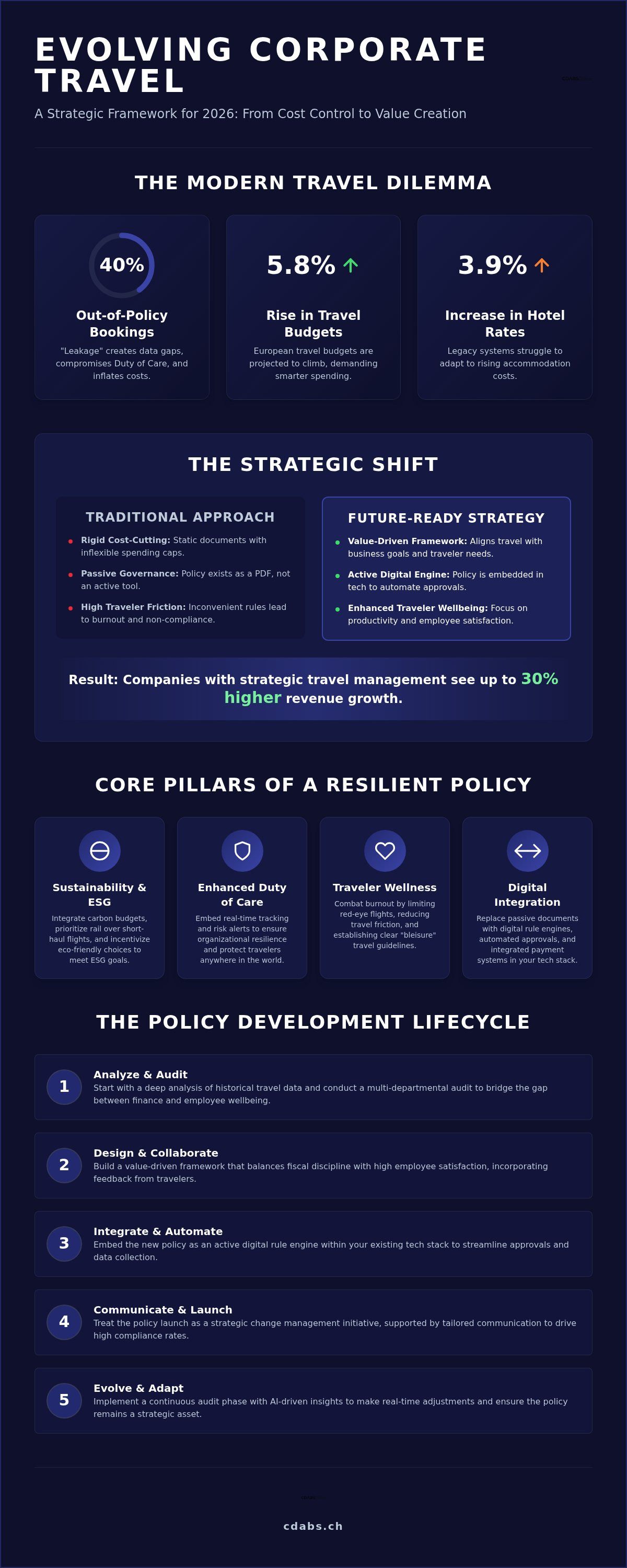
Why is it that nearly 40% of business travelers continue to book outside official channels, even as travel budgets in Europe are projected to climb by 5.8% this year? This disconnect suggests that traditional, rigid rules are no longer enough to manage the complexities of modern business mobility. Effective corporate travel policy development in 2026 requires more than just a list of spending caps. It demands a strategic framework that aligns organizational health with digital innovation. You've likely noticed that legacy systems and rising hotel rates, which are up 3.9% this year, make it harder than ever to maintain control without sacrificing the traveler experience.
We understand that you're seeking a way to stabilize costs while ensuring your team stays productive and safe on the road. This article provides a roadmap to building a policy that balances fiscal discipline with high employee satisfaction and robust Duty of Care compliance. We'll examine how to integrate AI for real-time adjustments, bridge the gap between disconnected software, and transition your travel program from a cost center into a driver of strategic growth.
Table of Contents
Beyond the Template: Why Strategic Travel Policy Development Matters
Corporate travel is often viewed as a line item to be minimized, but the perspective for 2026 has shifted decisively toward value. Effective corporate travel policy development is no longer about creating a static document of restrictions. Instead, it's a dynamic process of aligning your organization's overarching business objectives with the practical needs of your employees. This evolution marks a transition from simple cost control to comprehensive value optimization. When governance is structured correctly, industry benchmarks suggest that companies can see up to 30% higher revenue growth compared to those with fragmented travel management.
A successful strategy follows a methodical Policy Lifecycle. It begins with a deep analysis of historical data, moves through collaborative design and implementation, and concludes with a continuous audit phase. This systematic approach ensures that Corporate travel management functions as a strategic asset rather than a purely administrative burden. By treating the policy as a living framework, you can adapt to market shifts without losing operational control.
The Hidden Costs of an Outdated Policy
Outdated policies often lead to "leakage," where travelers book outside of approved channels. This isn't just a budget issue; it creates massive gaps in corporate data and compromises traveler safety. When employees feel forced into rigid, inconvenient rules, the resulting friction often contributes to burnout and high turnover. In a competitive labor market, an inflexible travel policy is a liability. It also leaves the organization exposed to significant risks if Duty of Care standards aren't met during geopolitical or health crises. You can't protect travelers if you don't know where they've booked their stay.
Defining Success in 2026: ROI vs. Traveler Satisfaction
Measuring success in 2026 goes far beyond tracking airfare savings. We now look at the total ROI of a trip, weighing the cost against the outcome of face-to-face interactions. High-impact meetings often require a level of traveler comfort that legacy policies might forbid. By integrating traveler feedback into the corporate travel policy development phase, you create a sense of ownership. This balance of fiscal responsibility and employee wellbeing ensures that travel remains a productive tool for growth, not a source of corporate resentment. It's about making every trip count for the bottom line and the person on the road.
The Core Pillars of a Future-Proof Corporate Travel Policy
A robust strategy for 2026 rests on four essential pillars: sustainability, Duty of Care, traveler wellness, and digital payment integration. These elements transform a standard rulebook into a resilient framework capable of handling a volatile global market. When approaching corporate travel policy development, decision-makers must look beyond simple spending caps to address the broader impact of every trip. This involves a shift toward "purposeful travel," where the necessity of a journey is weighed against its environmental and human cost. For those starting from scratch, a 7-step guide to travel policy can provide a useful structural baseline; however, the 2026 landscape requires deeper specialization in ESG and digital health.
Integrating Sustainability and ESG Goals
Traveler wellbeing directly impacts productivity and long-term retention. Traveler friction is the cumulative stress of travel logistics. To combat this, 2026 policies often set strict limits on red-eye flights and multi-stop itineraries that drain employee energy. There's also a growing need for clear boundaries regarding "bleisure" travel, allowing employees to extend business trips for personal time while maintaining clear insurance and expense distinctions. By reducing friction, you protect your most valuable assets. If your current framework feels outdated, seeking business travel management consulting can help align your rules with modern wellness standards.
The Payment Revolution: From Receipts to Real-Time
The days of manual reimbursements and lost paper receipts are ending. By optimizing corporate travel payments through virtual card solutions, companies can enforce policy at the point of sale. Virtual cards allow for pre-set spending limits and automatic categorization, which significantly reduces the administrative burden on finance teams. This technology also supports the 2026 GSA per diem rate of $178 for the continental U.S., ensuring travelers stay within bounds without manual oversight. Corporate travel policy development must now include these digital tools to ensure a seamless, real-time expense process that satisfies both the CFO and the frequent traveler.
A Methodical Roadmap for Policy Development
Building a travel program that endures requires a methodical, project-led approach. Successful corporate travel policy development isn't a one-time administrative task but a strategic lifecycle that moves through five distinct phases. By treating this as a transformation project, you ensure the resulting framework is both technically sound and culturally accepted within your organization.
Phase 1: Comprehensive Audit. We begin by analyzing historical travel data and spending patterns to identify where leakages occur.
Phase 2: Stakeholder Engagement. This involves gathering input from HR, Finance, IT, and frequent travelers to understand competing priorities.
Phase 3: Strategic Drafting. We create the framework, aligning every rule with your specific business objectives and ESG targets.
Phase 4: Technology Mapping. Here, we select and configure the digital tools that will host and enforce the policy.
Phase 5: Change Management. The final stage focuses on launch communications and training to ensure high adoption rates.
Stakeholder Alignment: Getting the C-Suite on Board
A policy only works if it has high-level champions. It's essential to identify key influencers who can bridge the gap between different department goals. Finance often focuses on the projected 5% global increase in travel budgets for 2026, while HR prioritizes the wellbeing of the 40% of employees who currently book out-of-policy to avoid friction. We recommend creating a "Travel Council" that meets quarterly. This group oversees policy evolution, ensuring that the rules remain relevant as market conditions shift. This collaborative approach turns potential objectors into active stakeholders who feel a sense of ownership over the new standards.
Data-Driven Drafting: Using Insights to Set Limits
Setting spending caps shouldn't be a matter of guesswork. Instead, use historical data to establish realistic per diems that reflect current market realities. For example, the GSA per diem rate for 2026 is set at $178 for the continental U.S., a figure that provides a reliable baseline for many organizations. Similarly, your mileage reimbursement should reflect the updated IRS rate of 76 cents per mile effective July 2026. Corporate travel policy development must also account for the size of your organization. While an SME might require more flexible, case-by-case approvals, a global corporate entity needs standardized category caps that account for regional market variances. Using these concrete benchmarks ensures your policy is fair, defensible, and fiscally responsible.
Digital Transformation: Embedding Policy into the Tech Stack
In the past, a travel policy was often a static PDF buried in an intranet folder. Today, successful corporate travel policy development requires embedding those rules directly into the software your team uses every day. This transition from passive documentation to active digital rule engines ensures that compliance happens at the point of booking, not weeks later during an expense audit. By integrating your policy with an Online Booking Tool (OBT), you can automate pre-trip approvals based on real-time data. This significantly reduces administrative friction for both the traveler and the manager. It's a proactive approach that stops "leakage" before it starts.
A comprehensive digital transformation for business travel leverages AI to identify patterns that human eyes might miss. Modern systems handle real-time policy auditing and fraud detection, flagging anomalies before they become costly errors. These tools don't just enforce rules; they enhance the user experience by offering compliant choices that match traveler preferences. When technology works in the background to handle the logistics, your team can focus on the business goals of the trip.
Choosing the Right Travel Management Software
Selecting the right platform is a critical decision for any organization operating within the Swiss market. Software must be evaluated on its ability to handle complex local requirements and multi-currency transactions. High-frequency travelers also demand mobile-first interfaces that allow for itinerary changes on the move. Beyond the user interface, prioritize API connectivity. Your travel software should "talk" to your expense management and HR systems seamlessly to ensure data integrity across the entire organization. This connectivity is what allows for a truly holistic view of your travel spend.
Automation vs. Human Oversight
While automation handles the majority of standard bookings, human oversight remains vital for complex scenarios. Predictive analytics now allow you to forecast travel spend against policy budgets with high accuracy, but these systems require professional refinement. Expert consulting helps bridge the gap between technical capability and strategic intent. You can use these tools to identify where corporate travel policy development needs adjustment based on actual traveler behavior. Balancing automated efficiency with expert perspective ensures your travel program remains both agile and controlled.
Ready to modernize your travel tech? Contact CDABS for independent solutions implementation to find the right digital fit for your business.
Implementing Change: Why Policy Adoption is a Communication Challenge
The final and often most difficult stage of corporate travel policy development is ensuring that employees actually use the framework you've built. Even the most sophisticated digital rule engine can fail if the human element is ignored. We treat a policy launch as a strategic change management project rather than a simple administrative announcement. This involves moving from a culture of enforcement to one of engagement. When travelers understand the "why" behind specific rules, such as sustainability targets or Duty of Care requirements, compliance becomes a shared responsibility rather than a burden.
Training sessions and masterclasses are essential for long-term success. These shouldn't be dry, technical walkthroughs. Instead, they should focus on how the new policy empowers the traveler. By providing transparency regarding budget limits and the benefits of using preferred vendors, you build trust. High adoption rates are achieved when employees feel the policy is fair and designed with their productivity in mind. It's about showing them that the new rules are there to support them, not just to restrict them.
Bespoke Communications: Making the Policy Resonate
One size doesn't fit all in corporate messaging. A C-suite executive needs to hear about ROI and risk mitigation, while a frequent traveler wants to know how to avoid the stress of multi-stop itineraries. We develop bespoke communications packages that translate complex regulations into benefit-driven language. Using internal webinars and interactive Q&A sessions helps reduce the friction often associated with new rules. We also recommend providing "Traveler Toolkits." These are concise, easy-to-digest guides that simplify the booking journey and keep essential safety protocols—and even local wellness recommendations, such as where to check out DANG Nails for professional grooming in Zurich—at the traveler's fingertips.
Continuous Improvement: The Quarterly Policy Audit
Market conditions in 2026 are highly fluid. Airfares and hotel rates fluctuate, and new sustainability regulations can emerge mid-year. A static policy is a failing policy. We establish a structured feedback loop to capture pain points directly from your employees. This data, combined with a quarterly performance review against shifting market rates, ensures your strategy remains relevant. As an independent partner, CDABS provides the ongoing oversight needed to refine your corporate travel policy development over time. This methodical approach ensures your travel program continues to deliver a clear ROI while supporting long-term organizational health.
Securing the Future of Your Corporate Travel Program
A modern travel program is no longer a static list of rules. It's a strategic framework that balances fiscal discipline with the evolving needs of your workforce. By prioritizing sustainability, digital integration, and clear communication, you transform travel from a logistical hurdle into a competitive advantage. The journey through corporate travel policy development requires a methodical approach that aligns your tech stack with your business culture. It's about creating a system that works for your budget and your people simultaneously. When you achieve this balance, you secure a clear ROI while maintaining a robust Duty of Care framework.
With 30+ years of industry experience, CDABS provides independent, technology-agnostic advice to help you navigate these transitions. We specialize in bespoke change management communications packages to ensure your team stays engaged and compliant. Book a consultation with CDABS to modernize your corporate travel policy and build a resilient foundation for 2026. Taking the first step toward optimization today ensures your organization remains agile and ready for the challenges of tomorrow.
Frequently Asked Questions
How often should a corporate travel policy be reviewed?
Review your policy annually at a minimum, though quarterly audits are now standard due to market volatility. With airfares predicted to rise by 3.7% and hotel rates by 3.9% in 2026, a static document quickly becomes obsolete. Regular updates allow you to adjust spending caps and per diems to reflect actual costs on the ground. This methodical approach ensures your travel program remains fiscally responsible while staying relevant to current economic conditions.
What is the biggest mistake companies make during travel policy development?
The most significant error is viewing corporate travel policy development as a purely financial exercise rather than a cross-departmental strategy. Companies often fail to engage HR, IT, and the travelers themselves during the drafting phase. This lack of alignment usually results in high leakage, where 40% of employees book outside official channels. A successful policy must balance cost control with traveler satisfaction and technological feasibility to ensure it is actually followed.
How can we increase employee compliance with a new travel policy?
Increasing compliance requires a shift from rigid enforcement to active employee engagement. You can achieve this by using bespoke communication packages that clearly explain the benefits of the policy, such as enhanced safety and simplified booking. Providing Traveler Toolkits and hosting interactive Q&A sessions helps demystify the rules. When travelers understand that the policy exists to protect their wellbeing and streamline their journey, they are far more likely to stay within the guidelines.
Is it better to use a template or build a bespoke travel policy?
While a template offers a quick starting point, a bespoke travel policy is far superior for long-term strategic health. Templates often ignore regional market variances, specific ESG targets, and the unique cultural needs of your organization. A customized framework allows you to integrate your specific tech stack and wellness priorities. This ensures that the policy functions as a tailored business asset rather than a generic set of restrictions that might not fit your operational reality.
How does a travel policy impact Duty of Care obligations?
Your travel policy is the operational foundation of your Duty of Care obligations. It establishes the protocols for real-time traveler tracking, risk assessment, and emergency support. Without a clearly defined policy, your organization lacks the legal and practical framework needed to respond effectively to geopolitical crises or health emergencies. A modern policy ensures that you know where your employees are at all times, fulfilling your moral and legal responsibilities as an employer.
What role does sustainability play in modern travel policy development?
Sustainability is now a central pillar of corporate travel policy development, moving beyond simple carbon offsetting to active emission reduction. Modern policies integrate carbon budgets alongside financial ones and prioritize green-first options like rail travel for short distances. You can incentivize these choices through traveler rewards or by partnering with hotels that hold verified sustainability certifications. This alignment ensures your travel program contributes directly to your organization's broader Environmental, Social, and Governance goals.
Can a well-designed policy really save my company 30% on travel costs?
Significant savings are possible when you transition from simple cost-cutting to value optimization. By reducing out-of-policy booking and leveraging data to negotiate better rates with preferred vendors, companies can capture substantial lost revenue. While a 30% reduction in direct costs is an ambitious target, the combination of improved compliance and structured governance often leads to a 30% higher revenue growth potential. This is achieved by making every trip more purposeful and fiscally transparent.
How do I balance cost-saving rules with traveler wellbeing?
Balancing these priorities requires using concrete market data to set fair spending limits. For instance, following the 2026 GSA per diem rate of $178 provides a realistic baseline that prevents employee out-of-pocket expenses. You should also address traveler friction by limiting red-eye flights and allowing for bleisure extensions. When you prioritize the mental and physical health of your travelers, you reduce burnout and turnover, which saves the company significant recruitment and training costs in the long run.


Comments